A lipstick covered in colorful rhinestones. A skincare bottle decorated with crystals. A compact covered in pearls and initials. Even everyday objects such as coffee cups, sheet masks and beauty tools are being transformed into sparkling personal accessories.
Bedazzled Beauty has quickly become one of the most visible beauty aesthetics across Instagram and TikTok.
The current wave accelerated rapidly in August 2026, with beauty brands, retailers and creators embracing rhinestones and playful customization across their social feeds. Fortune reported that brands including Sephora and Ulta Beauty had joined the trend, while creators were decorating everything from skincare products to coffee cups. One creator’s bedazzled content reportedly generated almost ten times the likes of her usual posts. Vogue Japan has since described #Bedazzling as a rapidly spreading Gen Z and Gen Alpha beauty trend, while ELLE has highlighted its connection to Y2K nostalgia and creative self-expression.
For beauty brands, it would be easy to interpret this as simply another rhinestone trend.
For product development managers, however, something more important may be happening.
Consumers increasingly want to participate in the product—not simply use it.
That has major implications for false eyelashes.
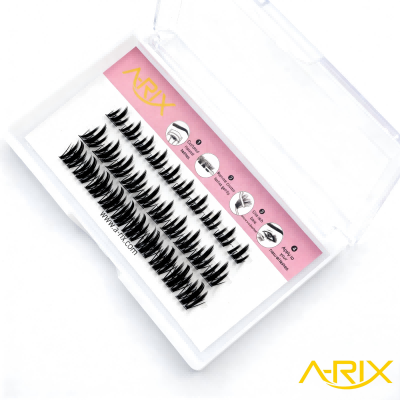
DIY cluster lashes have already transferred lash application from the salon to the consumer. If consumers are now comfortable designing their own lash maps, combining different clusters and even customizing their beauty packaging, the next stage of DIY may go much further.
The future opportunity may not simply be “Do It Yourself.”
It may become:
“Design It Yourself.”
From DIY 1.0 to DIY 2.0
The first generation of DIY lash innovation focused primarily on application.
Traditional strip lashes required glue and careful positioning. DIY clusters gave consumers more control over placement and eye shape. Bond-and-seal systems extended the at-home experience, while pre-glued clusters are reducing application steps even further.
The progression has largely been:
Strip Lash → DIY Cluster → Bond & Seal → Pre-Glued Cluster
Each innovation makes the application process easier.
But the product itself is still largely predetermined by the manufacturer.
The brand decides the curl.
The manufacturer decides the density.
The tray determines the available lengths.
The designer determines the packaging.
The customer still selects from finished options.
The next generation of products could change this relationship.
DIY 1.0: Apply it yourself.
DIY 2.0: Design it yourself.
Instead of simply deciding where to place a cluster, consumers could increasingly decide what their entire lash system looks like.
1. Bedazzling Shows the Power of the “Unfinished” Beauty Product
The most interesting part of Bedazzled Beauty is not rhinestones themselves.
The stronger idea is that a consumer is willing to buy a product and then spend additional time changing it.
This reverses a traditional product-development assumption.
Brands normally try to deliver a completely finished product.
Bedazzling suggests that, for some Gen Z consumers, deliberately leaving room for participation can actually increase enjoyment.
The brand may complete 80% of the product.
The consumer completes the final 20%.
That last 20% creates:
ownership, creativity, personalization and shareable content.
This concept could be applied directly to lash products.
Instead of launching a fully decorated lash box, a brand could provide a clean reusable case together with optional rhinestones, letters, pearls, charms or sticker packs.
The customer decides what the finished product becomes.
The message changes from:
“Here is your lash kit.”
to:
“Here is the system. Make it yours.”
This distinction may outlast the rhinestone trend itself.
Bedazzling may be temporary.
The desire for personalization is much more important.
2. The Next Customizable Product Could Be the Lash Map
False eyelashes are already naturally suited to personalization because eye shape and desired styling vary between consumers.
A traditional strip lash gives the consumer a predetermined result.
DIY clusters allow the result to be constructed.
A mixed tray containing:
8 mm, 10 mm, 12 mm, 14 mm and 16 mm
can produce very different looks.
For example, the same tray might create a soft everyday design, a doll-eye effect, a cat eye or a much more dramatic outer-corner look.
For product developers, this suggests an important shift:
Stop thinking only in “lash styles.”
Start thinking in lash-building systems.
Instead of selling:
“Natural Style 01”
a brand could sell:
Build Your Natural Look
The tray becomes a toolkit.
The brand can provide several suggested lash maps while allowing customers to create and share their own.
This has another important marketing benefit.
A single fixed lash style produces one main visual result.
A customizable tray can generate dozens of pieces of content:
5 Lash Maps From One Tray
Natural to Glam With the Same Clusters
My Custom Cat-Eye Map
Followers Choose My Lash Map
Product flexibility becomes content flexibility.
3. Modular Lashes: Could False Lashes Become “Lash Lego”?
Length customization is only the beginning.
A more advanced product architecture could separate lashes according to their function.
For example:
Base Clusters provide soft density.
Accent Spikes create definition.
Inner-Corner Clusters offer shorter, lighter fibers.
Outer-Corner Clusters create elongation.
The user can then combine these elements herself.
A Natural Base plus two longer spikes could become a soft anime look.
A Brown Base plus Black Accent Spikes could create subtle contrast.
A Wispy Base plus dramatic outer-corner pieces could become a night-out style.
This creates what could almost be described as:
Lash Lego
The manufacturer no longer needs to create a completely new finished lash for every micro-trend.
Instead, the brand develops a library of compatible components.
Consumers assemble the final style.
For a product development manager, this is potentially much more scalable than launching dozens of disconnected SKUs.
4. Color Can Become Another Layer of Personalization
False lashes have traditionally been dominated by one default color:
black.
But a modular DIY system creates room for much more variation.
Brown lashes are already a natural extension of softer makeup aesthetics, but customization could go further:
Espresso brown.
Soft brown.
Brown-black.
Burgundy.
Navy.
Colored tips.
Colored accent spikes.
Rather than launching an entire bright-blue lash, for example, a brand might offer a black base with two navy accent spikes.
That makes color more wearable.
It also allows consumers to coordinate lashes with:
eye makeup,
outfits,
events,
or moods.
The future false lash category may begin to behave less like a fixed beauty product and more like a fashion accessory system.
5. Refillable Lash Cases Could Turn Packaging Into Part of the Ecosystem
Bedazzled Beauty also raises an important packaging question.
If consumers enjoy personalizing a lash box, should that box really be disposable?
A more interesting product model could be:
Reusable Lash Case + Replaceable Lash Refills
The first purchase includes a durable case and lash tray.
The consumer can personalize the case with:
initials,
charms,
rhinestones,
stickers,
or themed accessories.
Later, she buys only replacement trays:
Natural Refill
Brown Refill
Wet Look Refill
Manga Refill
Volume Refill
This creates a completely different commercial model.
Instead of selling a disposable lash package every time, the brand creates an object the customer keeps.
That can increase emotional attachment and provide a stronger reason to remain within the same product ecosystem.
It also opens a useful path for packaging innovation.
The expensive or decorative element becomes reusable, while refill packaging can be simpler.
For brands increasingly thinking about packaging reduction and European PPWR requirements, that is worth exploring carefully.
6. Customization Does Not Have to End With the Physical Product
The next stage of lash personalization could also be digital.
Imagine a consumer visiting a lash brand website.
Instead of browsing 50 nearly identical products, she answers a few questions:
What is your eye shape?
What effect do you want?
How dramatic should the result be?
The platform then recommends:
Your Lash Map
8 – 10 – 12 – 12 – 14
The first generation of this system does not require complicated artificial intelligence.
A rule-based recommendation tool can already help consumers navigate products more confidently.
Later, brands could add photo-based eye-shape recognition, virtual lash visualization or AI-assisted mapping.
The purchasing journey then changes from:
Browse → Choose → Buy
to:
Describe Yourself → Customize → Buy
That is a much more personalized beauty experience.
7. Consumers Could Eventually Become Product Developers
One of the most interesting long-term possibilities is user-generated lash design.
A brand could provide an online interface where customers drag different lengths and components onto a virtual eye.
A user creates:
8 – 10 – 12 – 14 – 14
and names it:
Emma’s Soft Cat Eye
She posts it on Instagram.
Another customer sees the look and selects:
Shop This Lash Map
Now the original customer has done more than create UGC.
She has effectively created a sellable product configuration.
If a particular map becomes popular, the brand could eventually release it as a preconfigured tray or creator collaboration.
The development loop becomes:
Consumer Creation → Social Sharing → Community Adoption → Commercial Product
This is a significant change from the traditional beauty industry, where brands decide first and consumers respond later.
Future product development may become increasingly community-led.
8. The Biggest Manufacturing Challenge: Customization Without SKU Chaos
There is one obvious problem.
Unlimited customization can quickly become a supply-chain nightmare.
If every customer wants a different:
length, curl, density, color, spike, tray, and package,
the result can be hundreds or thousands of low-volume SKUs.
That is not efficient customization.
For manufacturers, the more practical strategy is:
80% Standardization + 20% Customization
For example, the factory might standardize a core component library around five lengths, several densities, several curls, four main lash structures and a controlled color range.
The front end appears highly flexible.
Consumers and brands can combine those components into many different results.
But the back end remains based on standardized manufacturing.
This is essentially mass customization.
The consumer sees:
Hundreds of possibilities.
The factory sees:
A manageable library of standardized components.
For product development managers, this distinction is critical.
The objective should not be to produce endless unique eyelashes.
It should be to build a modular architecture that produces endless-looking combinations.
What Can a Lash Supplier Do for Brands Exploring This Direction?
For eyelash suppliers, this trend creates an opportunity to move beyond traditional catalogue-based OEM manufacturing.
Instead of asking a customer only:
“Which existing style would you like?”
a supplier can help design the system behind the collection.
That may include developing standardized base clusters, multiple spike modules, mixed-length tray configurations, brown and accent-color options, reusable lash cases, refill structures and customizable packaging accessories.
A supplier can also help a brand test the concept gradually.
There is no need to launch 30 customized products immediately.
A first capsule collection might contain one mixed-length natural tray, one Base + Accent Spike Kit, one brown/black combination set and one customizable reusable case.
Consumer behavior can then answer the important questions.
Are customers actually creating different maps?
Which lengths disappear first?
Do users buy replacement trays?
Which combinations generate the most UGC?
Does customization improve repeat purchase?
These insights can guide the next collection.
For suppliers, the value is therefore no longer limited to manufacturing capacity.
The opportunity is to become a:
Product Development Partner
capable of translating fast-moving consumer trends into scalable product structures.
Bedazzling May Be Temporary. Personalization Is Not.
Rhinestones will not necessarily remain the dominant beauty aesthetic forever.
Today’s gems could become tomorrow’s charms, bows, stickers, letters, interchangeable accessories or something completely different.
That is why false lash brands should not build their entire strategy around bedazzling.
They should pay attention to what the trend reveals.
Consumers increasingly enjoy:
participation, personalization, creativity and ownership.
DIY cluster lashes have already given consumers control over application.
The next stage can give them control over the product itself:
the map, the length, the spike, the color, the case,
and eventually the entire lash configuration.
For lash suppliers and product development managers, that creates a new question.
Not:
“What is the next bestselling lash style?”
but:
“How can we build a system that lets consumers create the next style themselves?”
That may be one of the most important directions for the next generation of false eyelashes.