A purchase order line that reads “W shape, 5D, 0.07, C curl” covers the fiber and the curl, but tips per fan, wing angle, and stagger sit outside that line, and those three decide whether a tray reads as W shaped eyelash extensions on the eye. The five bench checks below cover each one, with the acceptance numbers recorded the way our QC bench records them.
W shaped eyelash extensions, listed by many brands as W lash extensions or clover lashes, now sit second behind classic volume trays in our extension shipments into the US and Poland over the last eighteen months. The effect is specific: strands grouped at a shared base, opening into two wings with a dip between them, so the finished set reads like a small letter sitting on the lash line rather than a round puff. Retail listings under this style convert well, and salons adopted the construction because it removes hand-fanning from the chair.
The style carries failure modes that classic volume trays do not, and because the tray looks correct in the box, the failures appear only after application. The checks below are the ones our QC bench runs on every W production lot before shipment, and they run the same way on a competitor’s sample of W lashes.
What W shaped eyelash extensions mean on a spec sheet
Before a tray goes near a purchase order, measure the four traits below. None of them is implied by “W shape” alone, and a standard volume tray with a trend label passes none of them.
- Tips per fan.Whether the strand count survives the pickup. The working value is 3 strands for a 3D fan and 5 strands for a 5D fan after a full rotation.
- Wing angle.How far the two outer strands lean from the center. The working value is a narrow lean of 30 to 45 degrees for elongation, and the test is a top-down photograph against a gridded card.
- Whether the strands leave the base at slightly different lengths. The working value is a step of 0.5 to 1 mm between adjacent strands, and the test is the same top-down photograph.
- Base width.How much room the bonded root takes on the lash line. The working value is 2 to 4 mm on a 5D base, confirmed with a ruler against the reference photograph.
A tray can pass two of the four and still sell as W shape, which is what relabeled stock from general volume production does, so ask the supplier which of the four their W line actually controls, and record the answer on the order itself.
The two W lash product types
Which of the two constructions a brand should order depends on who applies the set. The W lash range carries both, and the working differences are easier to see side by side:
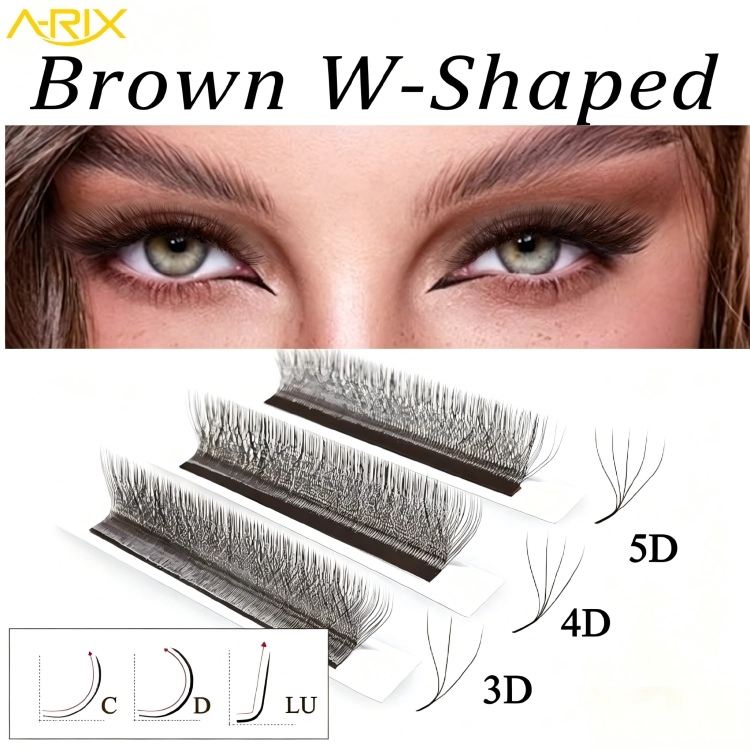
Type A, the clover W in brown
- Construction: single fans that open into a 3D to 5D clover when picked, with the strands crisscrossing enough to fill gaps along the line
- Reference tray: the brown W-shaped tray, deep espresso brown PBT, matte finish, C and D curls steam-processed to hold past twenty-four months
- Weight: roughly twenty percent below the older synthetic fiber, which keeps the set comfortable on fine natural lashes
- Order this type when: the menu sells soft glam to blonde, red-haired, or fair-skinned clients, the group that finds jet black too hard against their coloring
- Watch for: a bond line that catches light against the brown fiber.
Type B, the slant flying foxy W in black
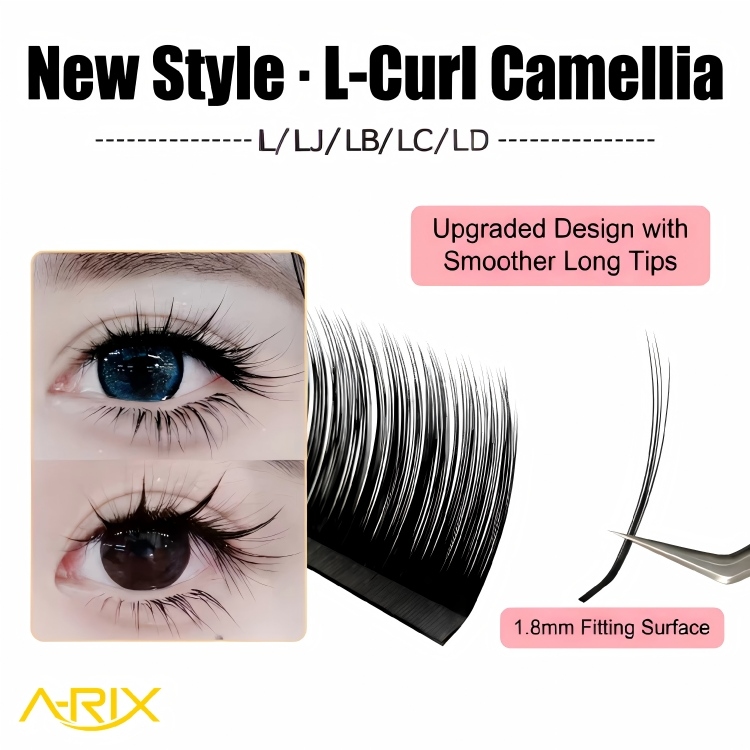
- Construction: five-strand fans pre-formed with a narrow wing angle toward the outer corner and a staggered spiky finish, picked and placed as units
- Reference tray: the foxy slant flying tray, Korean PBT at 0.05 and 0.07 mm, matte black, 8 to 15 mm, and twelve curls from J through B, C, C+, D, D+, L, LJ, LC, LB, LD, and M
- Application: nothing gets fanned at the chair, so treatment time drops and results stay uniform across technicians of different skill levels
- Order this type when: the salon runs high-volume fox-eye and cat-eye menus, or the buyer resells to beginners
- Watch for: drift in the wing angle across the tray, and the bond line.
Keep one type as the hero product on the first run, because a mixed first order produces no data on which style customers reorder, and the second order then has to be placed on guesswork.
Five checks before approving a W lash sample
Run all five on the sample tray, in this order, and record the numbers as they come off the bench. The whole sequence fits inside an hour and needs nothing more than tweezers, a phone camera, a white card, a gridded card, and a kettle.
One rotation answers whether the tray is actually W shaped.
- Pick one fan from the strip the way a technician would, at the base, with a straight isolation tweezer.
- Hold the fan up and rotate it slowly through a full turn.
- Count how many strands stay in the wings and how many drift out.
- Repeat on ten fans spread across the tray, one from each row.
- Record: strands retained per fan, out of ten fans.
A pass is eight or more fans holding all five strands through the rotation, while a tray where three or fewer hold together has a base bond that is missing or worn, and it will produce a ragged, undefined set that customers do not recognize as the style they ordered. Since product photographs never show wing angle or stagger, this remains the most common rejection reason at our bench.
For both constructions, the bonded root is the part the client photographs first.
- Pick five fans with a volume tweezer, gripping at the middle of the base.
- Inspect each base under the phone flashlight, angled at forty-five degrees.
- Measure the base width; most 5D W bases sit in the 2 to 4 mm range.
- Check for loose fibers at the root and for a bond line darker or shinier than the fiber.
- Record: base width in mm, loose-fiber count out of five.
Once the set is applied, a wide or glossy bond line reads as a dark bar at the lash line, and customers photograph that bar long before they photograph the spikes. The brown clover carries the same risk in a quieter form, because a glossy bond catches light as a stray black dot against the matte fiber, so brown trays need the flashlight pass even more than black ones do.
Brown pigment drifts between production lots far more than black does, so this check applies whenever the order is the clover tray.
- Lay fibers from the new sample beside the previously approved lot on a white card.
- Photograph under daylight-balanced light, not the bench lamp, and not with the flash.
- Grade the match in three steps: same brown, warmer, or cooler.
- Record: pass or fail, plus the comparison photo.
Keep that photograph, because brown pigment drifts between production lots, and the photograph is what allows a later lot to be rejected on evidence rather than memory.
Although our trays are steam-processed to hold curl past twenty-four months, the storage conditions on the buyer’s side decide more than the factory claim does.
- Take six fans and photograph them from the side on a gridded card.
- Place them in a sealed container above hot water vapor for thirty seconds, no direct contact.
- Dry one hour at room temperature.
- Photograph again from the same position.
- Record: curvature change at the tip, before and after.
A curl that moved more than about 1 mm at the tip points either to an under-processed fiber or to a tray that was heat-cycled in transit, and the same movement will repeat on a shelf in Dubai or in a car in Arizona. The before-and-after photograph also settles, with evidence, the curl complaints that get attributed to the customer’s climate.
Give one tray of each type to the technician who applies the most sets per week, and time ten applications of each, measured from pickup to placement.
Record seconds per application for both trays. The pre-fanned construction should come in close to classic-set time, since nothing is fanned at the chair, and a W tray that runs slower than the volume tray already in use points to a base that splits on the second grip.
The order fields that prevent the re-order argument
Most of the W-lash disputes that reach our after-sales desk turn out not to be quality disputes at all, but specification gaps that both sides filled in differently, each convinced it had specified enough. Five fields, written out on every purchase order, close most of that gap.
- Tips retained at pickup.3D or 5D on the box is a strip claim. State the strand count that survives rotation, which is the figure
- Wing angle class.Narrow for fox-eye work, wide for round volume. The two classes look similar in a thumbnail and are not interchangeable.
- Color and tone.Black, or the brown tone agreed on the Note which photograph, and attach it to the order.
- Stagger depth.Uniform strands, or stepped in 0.5 mm terms. Less reads geometric on the eye; more reads feathered.
- Length and curl map by zone.The foxy construction typically runs 12 to 14 mm through the outer third and steps down toward 9 or 10 mm at the inner corner. State the mapping, not just the word “cat eye”.
Each field takes one minute to write and saves a sample round. Standard terms sit on top of these: MOQ and private label options follow the same structure as the rest of the extension range, custom packaging is quoted separately, and lead time runs 7 to 30 days depending on order size and season. Sample terms for new brand partners are on the process page.
The three failure modes, and what each one costs
Three complaints account for nearly everything that comes back to our after-sales desk on W shaped eyelash extensions.
Shedding strands (both types). These arrive as technician complaints rather than end-customer reviews, which delays detection by a full reorder cycle. By the time the sales curve shows the gap, the studio has quietly stopped using the tray and will not reorder.
Visible bond lines (Type B). These arrive fast and in customer photographs, as the dark bar at the lash line described under. The refund requests and public reviews they generate attach themselves to the product listing permanently.
Curl loss in hot climates. This one shows up in the US Southwest, the Gulf, and tropical Brazil, the three hottest markets we ship this style into. It produces a three-way argument between brand, factory, and courier that ends unresolved unless somebody holds a before-and-after photograph, which is the practical reason exists.
Prevention for all three costs minutes, while replacement costs a customer. The brown clover tray we currently ship answers the weight objection with a fiber roughly twenty percent lighter than the older synthetic, and verifies the bond line on the buyer’s side before the order rather than after it.
Questions buyers ask before the first W lash order
Do W shaped eyelash extensions need a special glue or sealer? No. The pre-fanned base works with standard extension adhesive. Adding sealer at the root actually stiffens the bond line and shortens the life of the set, and neither construction needs a primer.
Can we get the foxy W in brown? The elongation effect depends on contrast between the dark lash line and the eye, which matte black delivers most reliably. Brown PBT exists in our range, but the lift reads weaker at the same wing angle, and we say so on the sample report rather than let the listing oversell it.
What is the minimum order for a private label W tray? The same structure as the rest of the extension range, since the tray construction is identical and only the fanning jig and packaging differ. Custom packaging is quoted separately.
How many rows per tray, and how many sets does one tray cover? Row count varies with the curl and length mix. A standard 12-row 0.07 tray covers roughly 15 to 20 full sets for a mid-length cat-eye mapping,.
How the W sits in a wider lash line
Brands adding W shaped eyelash extensions in 2026 usually place them as the texture piece between a natural classic line and one dense volume line. What the construction does is remove hand-fanning from the chair while keeping the cat-eye read, and its margin carries the private label packaging investment that a trend style justifies. The collection logic in our earlier piece on building a profitable lash collection applies here with one addition: since the W is a technique product, the reorder comes from studios that adopted it into their menu, and the first order should stay tight and let the reorder set the second one.
Sample discipline remains what it is for any extension line. Our earlier checklist on evaluating lash samples covers the general case, the five checks above add the ones specific to the W, and pickup integrity goes first, since it is the one property that product photography can never show. The spike specification background sits in our premade spikes piece, and the wing-angle record from plugs directly into that framework.