Eyelash Trends 2027: What Lash Brands Should Be Stocking Now
Every October we run what our sales team calls the trend meeting. It’s not glamorous. We pull our sample-room log for the year, count how many sampling requests came in for each style family, and compare it against last year. Two hundred and some requests don’t lie. Marketing decks can say anything; a sample log is just people with budgets asking for things.
This year the meeting ran longer than usual, because one of our US distributors asked a blunt question: “I don’t want the Instagram version. What should I actually put money behind for spring 2027?”
Good question. So here’s the answer, built from our own order book and sample log rather than from moodboards. Seven things are coming. Not all of them deserve equal shelf space — I’ll say which ones do.
First, a word on timing, because this is the part buyers get wrong
Trends in lashes don’t move as fast as trends in fashion, but they move faster than most buyers plan for. A style that goes viral in March shows up in sample requests within weeks. By the time it hits the trade blogs, the factories that move early are already holding tooling and fiber stock for it.
The math is simple. Sample rounds take two to four weeks. Production runs five to twenty days depending on the style and whether the fiber for your curl is on the shelf. Packaging proofs add another week if you’re doing custom boxes. So a product you want on shelves in February needs a decision from you in November or December. Which, if you’re reading this when it publishes, is now.
The brands that win trend cycles aren’t the ones who spot trends first. They’re the ones who can say yes to one fast.
Trend one: wet look is a category now, not a fad
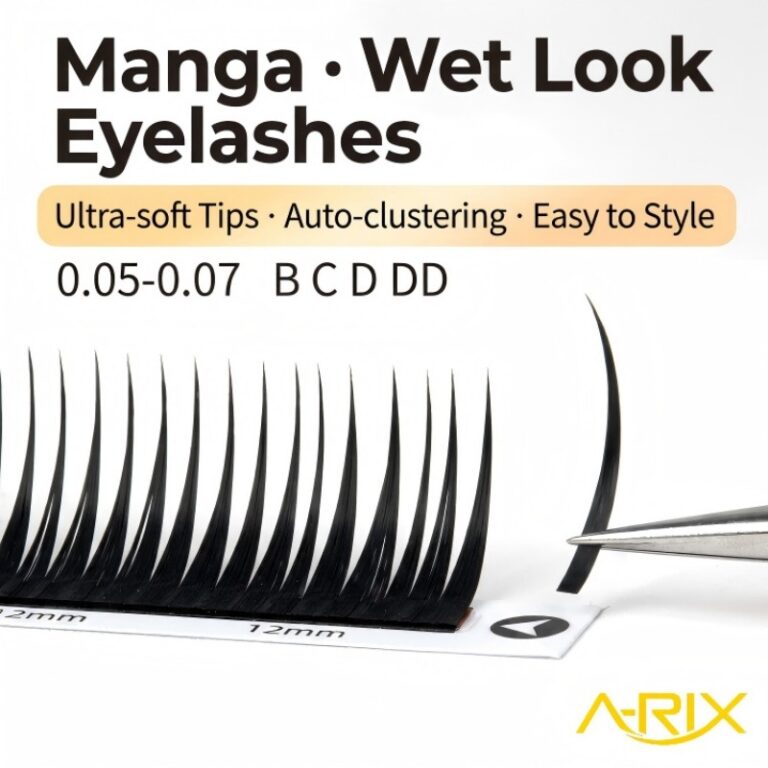
We’ve been watching wet-look lashes for three years, half expecting them to fade. They haven’t. The glossy, clumped, “just showered” finish has settled into something boring and reliable — which in cosmetics is a compliment.
In our sample log, wet-look requests roughly tripled between 2024 and this year, and the buyers changed too. Early on it was indie brands chasing a viral look. Now it’s established brands adding a wet-look SKU to a core line, which is what happens when a style graduates from trend to staple.
What matters technically: wet look lives or dies on fiber quality and glue control. Cheap fibers won’t hold the clumped definition, and the finish reads as messy instead of dewy. If you’re quoting this style, sample it properly before you judge it — a bad wet-look sample and a good one look like different products.
Trend two: manga spikes are leaving cosplay
Anime-adjacent styles — sharp, separated, deliberate spikes — started in cosplay and Japanese street fashion. They’re now showing up in mainstream Western retail, softened just enough for daily wear. Our premade spike styles went from a niche SKU to one of the more frequent sample requests of the year.
Two things I’d tell a buyer considering this space. One: the money is in premade spikes for DIY cluster users, not just full strip sets, because hand-creating spikes from extensions takes skill most consumers don’t have. Two: quality control is brutal on this style. A bent or merged spike is instantly visible — there’s nowhere to hide. Reject rates on poorly made spike styles run high, and the returns show up on your listing, not ours.
We profiled part of this shift in our piece on wispy and premade spike textures, and nothing since has changed my mind about where it’s going.
Trend three: brown has quietly become a top-three color
Here’s the one that surprises people looking only at social media. Black still dominates by volume, obviously. But brown lashes have grown from a rounding error to a real share of our sample requests, and the requests come from the brands with the strongest repeat rates.
Why? Brown reads softer on camera, pairs with the warm-toned makeup that’s dominated for two years, and — this is the commercial part — it opens up customers who find black too harsh. Older buyers. Fairer complexions. People who want definition without the drama. That’s a genuinely new customer, not a substitution.
If you add brown, add it across your hero styles rather than as one standalone SKU. A single brown tray sits on the shelf; brown versions of your three best-selling curls move. And check the fiber dye lot consistency when you sample — brown shows batch variation more than black does. It’s a darker version of the problem we described in our curl consistency guide.
Trend four: fox-eye and lifting shapes keep growing
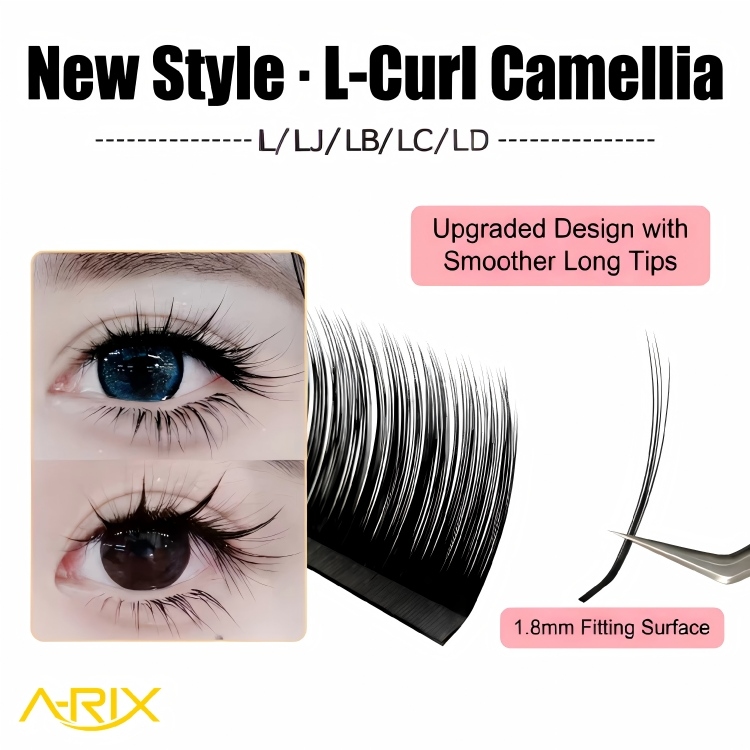
The elongated, outer-lifted look — fox eye, cat eye, whatever your market calls it — has been building for three years and hasn’t peaked. It’s driven partly by the makeup technique of the same name and partly by L and LC curls doing the visual work that used to need surgical threads.
For 2027 I’d expect this to fragment a little: more asymmetric designs, more styles built specifically for hooded or deep-set eyes, where a generic cat-eye strip sits wrong and customers complain. Brands who build for eye shape instead of just for curl letter will take share here. If you’re unsure which curls do what, our curl chart breakdown covers C, D, L, LC and LD in plain language.
Trend five: DIY clusters keep eating salon demand — and pre-glued is the next fight
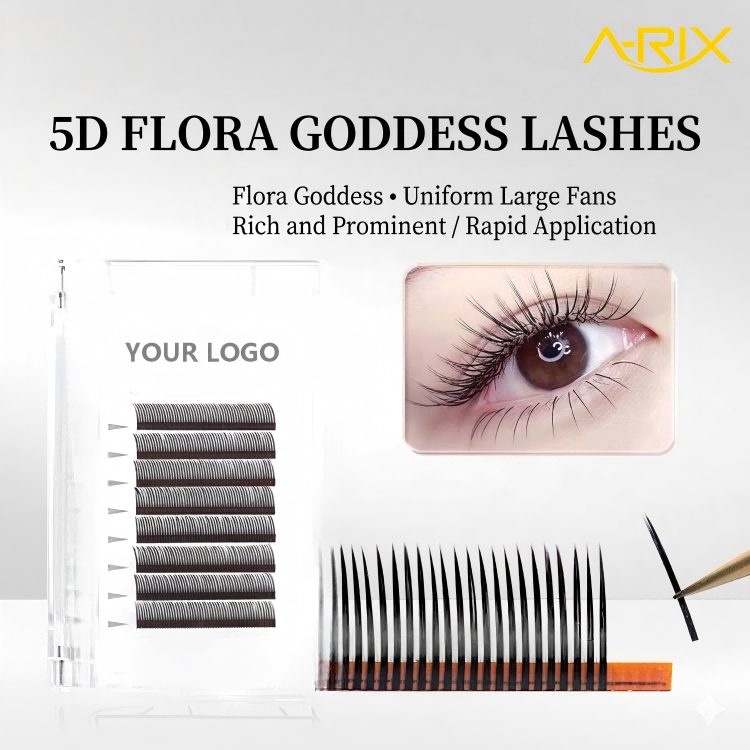
This one is less a trend than a structural shift, but it’s reshaping ordering patterns, so it belongs on the list. DIY cluster lashes let people build extension-style looks at home in minutes. Every month that the glue-and-applicator learning curve gets easier, a few more salon-extension customers drift to clusters.
The 2027 battleground is friction. Pre-glued and self-adhesive clusters — no glue bottle, no waiting, press and done — already exist, and every version we’ve sampled has tradeoffs between hold time and residue. But the direction is obvious: the format that removes one more step from the routine wins. I’d expect pre-glued variants to be the fastest-growing cluster sub-segment next year.
For buyers this changes the kit conversation. It’s not just clusters plus glue plus applicator anymore. The winning kits next year will be the ones with the shortest instructions. We build a lot of these — our DIY cluster lash range is the backbone of our production volume, and the assortment logic behind a good kit matters more than any single tray. We’ve written about that kit matrix separately if you’re planning one.
Trend six: invisible bands stop being optional
Band thickness used to be a spec nobody asked about. Not anymore. Buyers now routinely specify thin bands up front, and the laser-cut bands we run at roughly 0.035 millimeters have gone from a curiosity to a third of our new-style sampling requests.
The logic is simple and consumer-visible: a thin band disappears on the eye, so the lashes float, and cameras — which is to say, your customers’ phones — can’t catch the band line. For brands, it’s also a story that’s easy to tell in a listing without sounding like everyone else.
Fair warning from the factory floor: thin bands demand better fiber and slower handling, so the lowest quotes you’ll see for them are usually cutting exactly the corners that make the band fail. We’ve covered what the 0.035mm band actually changes for a brand, including the failure modes, in an earlier piece.
Trend seven: proof of materials becomes a selling point
Vegan and cruelty-free claims have been table stakes for years. What’s changing in 2027 is that retailers and marketplaces are starting to ask for the paperwork behind the claim — fiber origin, adhesive composition, test reports — not just the badge on the box.
All our lashes are PBT fiber, synthetic from spool to tray, so this is an easy conversation for us. But I’d flag it for buyers regardless of supplier: ask for the documentation now, before a retail partner asks you for it. The brands that can produce a material spec sheet within a day are the ones who keep their listings when platforms tighten requirements. The cost difference between fibers, and what you’re actually paying for with PBT, is spelled out in our PBT versus polyester comparison.
What this means for your 2027 line, practically
Not every trend deserves equal money. If I were allocating a 2027 budget for a mid-size lash brand, here’s roughly how I’d weight it:
- Core refresh first — brown versions and a thin-band version of your top two sellers. Low risk, high repeat.
- One wet-look SKU if you don’t have one. It’s past the risky phase of the curve.
- One manga-spike product, positioned for the DIY cluster crowd rather than costume buyers.
- Pre-glued cluster kits, if your supply chain can support the glue technology — this is where the growth is steepest.
- Fox-eye or eye-shape-specific styles only if your customer data already leans that way. Otherwise wait a cycle.
And one process note. Whatever you pick, lock your packaging proofs early. Our peak production window before the spring season fills fast, and packaging is where first orders slip — not the lashes. A signed-off proof in December is worth more than any trend call.
If you want a second opinion on your 2027 assortment, send us your current lineup and your market. We’ll tell you honestly which trends fit it and which ones we’d skip — we’d rather have you win with three styles than drown with fifteen.
FAQ
When should I order to catch spring 2027 trends?
Work backwards from your launch date: samples two to four weeks, production five to twenty days, packaging proofs about a week, plus shipping. For a February launch, decisions need to happen by early December at the latest.
Which 2027 lash trend has the lowest risk for a small brand?
Brown fibers on your existing best-selling styles. No new shape tooling, no new curl, and it addresses a customer base you’re probably missing today. Wet look is a close second.
Are manga-style lashes just for cosplay now?
No. The style has been softening into mainstream retail for about two years, especially as premade spikes for DIY cluster users. The cosplay origin still influences the aesthetic, but the buyers are ordinary consumers.
What are pre-glued cluster lashes and are they worth adding?
Clusters that arrive with adhesive already applied — press on, no glue bottle. Hold times and residue behavior vary by manufacturer, so sample before committing, but they’re the fastest-growing part of the DIY cluster segment and worth testing in 2027.
A-RIX has manufactured false eyelashes since 2003 — 5,000㎡ of factory floor, 200-plus people, and a sample room that logs every request, which is where the numbers in this article came from. If you’re planning a 2027 line and want our read on your specific market, start here to see how we work, or browse the DIY cluster range that most of these trends will run through. Trend meetings are monthly. You’re welcome to the minutes.