Selling Lashes in the Gulf: What Middle East Buyers Actually Ask For
Every October we stand in a hall at the Dubai World Trade Centre for Beautyworld Middle East, and every year the first two days teach us something the emails never did. Last month a salon group owner from Riyadh walked our stand, picked up a camellia tray, fanned it open with one finger and said: “This. But denser. My clients cover their brows.”
Six words in, and he had said more about the Gulf market than most market reports manage in thirty pages.
We’ve been shipping lashes into the GCC for over a decade now — Saudi, the UAE, Kuwait, Qatar, Oman, and a steady stream of re-export orders that leave Dubai for North and East Africa. It is one of our most consistent regions, and it is also the one where generic advice falls apart fastest. A spec sheet that sells in Berlin underperforms in Doha, and it’s rarely about quality. It’s about what the customer in front of the mirror actually wants, and what the climate does to your product between our dock and her chair.
The Gulf is a salon market first, a retail market second
This is the single biggest thing brands get wrong. In most of Europe and North America, the money is in DIY clusters and strip lashes sold online or in drugstores. In the GCC, the money is still in the salon chair. Eyelash extension — individual fans, volume sets, refills every two to three weeks — is a standard part of the beauty routine for a large share of women in Saudi Arabia and the UAE, and the salon density in Riyadh or Dubai Marina dwarfs what you’d find in a comparable European city.
What does that mean for a buyer? Your volume matters differently. A European distributor orders small mixed cartons of retail boxes. A Gulf distributor orders trays — thousands of them — because a single busy salon can burn through a hundred trays a quarter. When we quote for Middle East clients, the conversation starts with tray counts, curl mix ratios and refill economics, not with pouch design.
The retail side is growing, to be fair. DIY cluster kits have picked up in the last two years, mostly through salon retail shelves and Instagram-driven boutiques rather than drugstores. But it’s still the second channel, and if you’re planning your first Gulf order around a retail price point, you’re solving a problem that region doesn’t have yet.
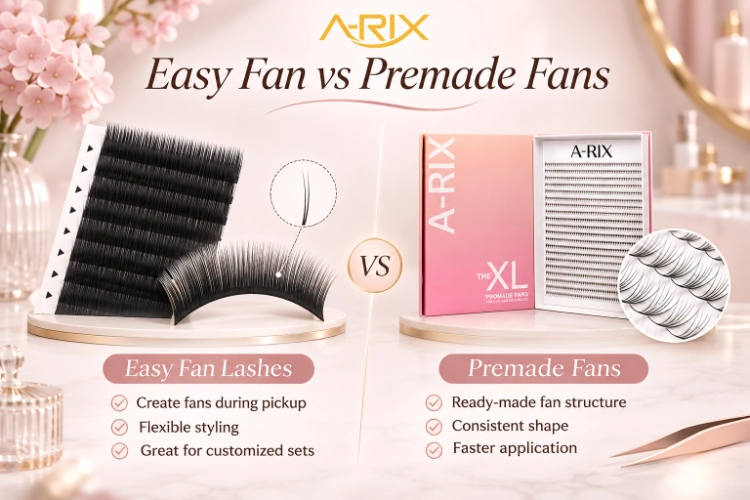
If salon volume is your lane, start from the tray format itself — we covered the structural side in our eyelash extension range, and most of what applies to curl mixing applies double in this region.
Density, drama, and the “cover the brow” brief
The Gulf aesthetic leans fuller than the Western natural look. Much fuller. The look that sells is a dense, layered, fluffy fan — often multi-length, often extending well up the lid, sometimes with a deliberate cat-eye or fox-eye elongation. When a buyer from Jeddah says “natural,” she does not mean what a buyer from Amsterdam means by “natural.”
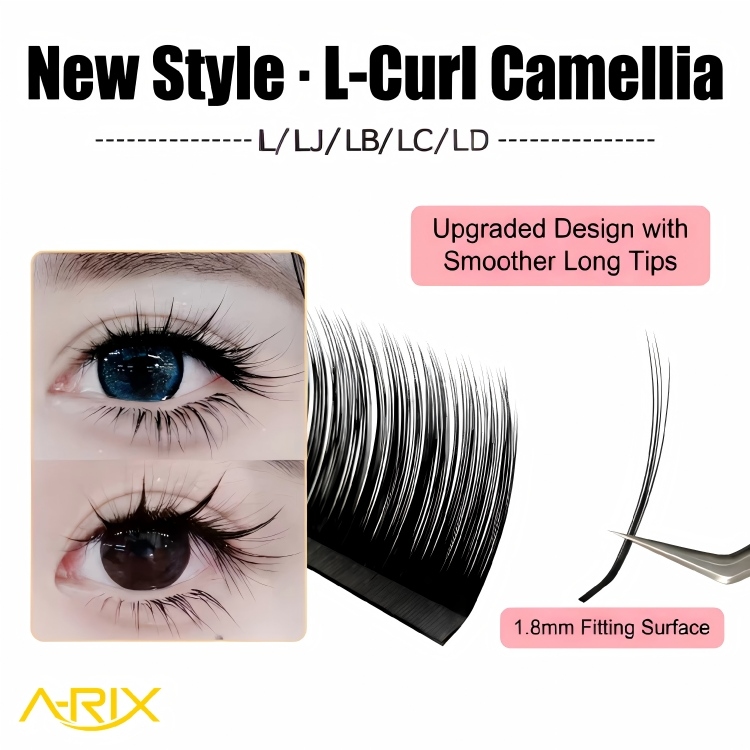
We manufacture a specific construction for this: the multi-layer camellia build, where each strip mixes two or three lengths in a repeating pattern so the finished set reads full but not flat. It sells disproportionately well across the GCC. The Arabician-effect 5D multi-layer fans in our catalogue came out of exactly those conversations — requests for maximum density without the heaviness you get from simply stacking more fiber onto a single-length fan.
Two practical notes for anyone building a Gulf-first range. First, curl: D and LC curls dominate, because the demand is lift and openness on deeper-set eyes; C is a supporting player, not the lead. Second, brown exists in the region but it’s a niche within a niche — dark black with a soft matte finish is the workhorse, and brown sells as the “softer day look” in upscale salons, not as a mass line.
Heat is not a marketing line, it’s a logistics problem
Here’s the part nobody puts on a trade show banner. From June to September, a container sitting on a dock in Jebel Ali can reach internal temperatures north of 50°C. If your product is pre-glued anything, or if the adhesive is packed in anything short of a proper barrier, the Gulf summer will find the weakness in your spec before your customer does.
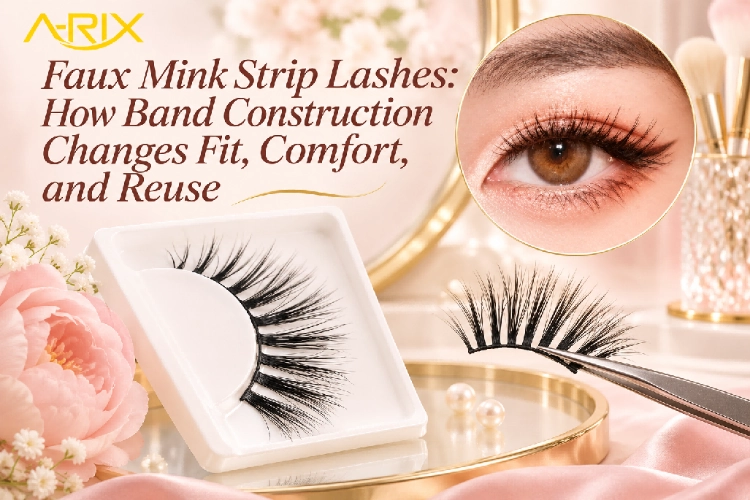
We learned this the expensive way, years back, with a strip lash order where the band tips softened in transit and the trays arrived looking slightly drunk. Since then, Gulf-bound orders get the full treatment: dehumidified packing, foil barrier for anything adhesive-related, and a standing rule that we don’t ship pre-glued SKUs into the region between mid-June and mid-September without the client signing off on the packaging spec in writing.
For extension buyers the issue shows up differently — as curl retention complaints. A lash that holds a perfect D curl in a European salon can relax a touch in a Gulf one, where the car is an oven and the walk from the car is long. PBT fiber holds its shape better than polyester under thermal stress, which is one of the reasons the region’s better salons have moved to PBT wholesale over the past few years. We broke down the PBT versus polyester trade-off in an earlier article; in the Gulf, the case for PBT is about as clear-cut as it gets.
Ramadan, Eid, and a calendar you must plan around
If you take one operational thing from this article, take this: the Gulf beauty calendar bends around Ramadan and the two Eids.
Ramadan itself is quieter for salons — evening hours, adjusted routines, bookings dip. Then Eid arrives and it is, without exaggeration, the busiest stretch of the Gulf beauty year. Weddings stack into the Eid window. Every salon in the country is fully booked for weeks. Lash artists buy inventory for that rush six to eight weeks ahead, and distributors buy from us ten to twelve weeks ahead, because sea freight into the region plus customs clearance eats a month on its own.
Same logic, smaller scale, applies around the Dubai shopping festival in winter and the wedding season that runs roughly October through spring. If your pitch to a Gulf distributor lands in February for a Ramadan delivery, you are already too late, and no air freight heroics will fully rescue a first order that needed sample approval first.
Dubai is a customer and a warehouse
A surprising share of our Gulf volume doesn’t end in the UAE at all. Dubai functions as a re-export hub for the wider region — goods clear into a free zone, get re-labelled or repacked, and move on to Saudi Arabia, Kuwait, Qatar, or across the water into Africa. A distributor in Al Quoz might be serving forty salons in three countries.
That changes what “custom packaging” has to mean. Arabic labelling requirements are now standard for retail goods moving into Saudi Arabia, and increasingly expected in the UAE too. Mixed-language cartons, country-specific barcode stickers, and packaging that survives a second handling cycle in a free-zone warehouse — these come up on virtually every Gulf order we run. It’s routine for us now, but if your current supplier has never done Arabic artwork, expect that conversation to take longer than either of you plans for. Our custom packaging line handles Arabic and bilingual layouts regularly, and honestly the artwork approval loop is the slowest part of the whole process. Start it early.
What Gulf buyers actually ask us, in order
- Density and layering first — can this fan read full at a distance of one metre? Show me the multi-length option.
- Curl mix — what D-to-LC ratio holds on deep-set eyes without touching the brow bone?
- Heat and humidity performance — fiber type, curl retention data, and for pre-glued items, the packaging barrier spec.
- Tray economics — lashes per tray, refills per salon per month, and what the per-day cost looks like for a working lash artist.
- Ramadan and Eid timelines — can you land the goods eight weeks before Eid, with samples approved before that?
- Arabic labelling and re-export paperwork — bilingual artwork, barcode variants per country, mixed-container consolidation.
Notice what isn’t top of the list: price. Price matters, of course it does, and the region has its share of bottom-feeders. But the Gulf salon sector is professionalised and reputation-driven — an artist who loses clients over lash retention loses more than the discount she saved. The buyers who stay with us year after year are rarely the ones hunting the lowest tray price. They’re the ones hunting consistency across ten thousand trays.
If you’re planning your first Gulf order
Don’t build the range around a Western bestseller and hope it translates. Start with two or three dense multi-layer constructions, one dramatic and one “soft full,” in D and LC curls, black matte, PBT. Get samples into the hands of two or three working lash artists in the market — not distributors, artists — and ask them one question: would you put this on a bride? That answer is worth more than any trend deck.
Then work the calendar backwards from Eid, add six weeks of buffer, and lock your packaging artwork before you confirm production. The region rewards suppliers who plan around its rhythm, and quietly drops the ones who treat it like any other export destination.
We’ll be back at Beautyworld Middle East next year, and at our process page you can see how a first order runs from inquiry to loading. If you’re targeting the GCC and want a straight answer on what to put in the container, send us the market you’re aiming at and we’ll tell you honestly whether our range fits it — or what we’d change before you spend money.
FAQ
What lash styles sell best in the Middle East market?
Dense multi-layer volume fans — camellia and multi-length constructions in D and LC curls, matte black, usually in the dramatic-to-full range. The “soft natural” Western look is a niche there; salon clients overwhelmingly ask for visible density and lift.
When should I order lashes for the Ramadan and Eid season?
Work backwards from Eid: distributors should confirm orders roughly 10 to 12 weeks ahead, since sample approval plus sea freight and customs into the GCC takes about a month on its own. Salons and local distributors buy 6 to 8 weeks out, so your stock needs to be in-country before they start.
Do lashes need Arabic labelling for Saudi Arabia and the UAE?
For retail-packaged goods, yes — Arabic labelling is required for Saudi Arabia and is increasingly expected in the UAE. Professional tray products sold salon-only have lighter requirements, but bilingual cartons are now the norm for anything moving through Gulf distribution, especially goods re-exported from Dubai.
Does the Gulf heat damage eyelash products in transit?
It can. Container interiors in Gulf summers regularly exceed 50°C, which softens adhesive, relaxes lower-grade fibers and warps cheap trays. PBT fiber holds curl well under thermal stress, and adhesive products need foil barrier packaging and dehumidified packing. We avoid shipping pre-glued SKUs into the region at the height of summer without a signed packaging spec.
Is DIY cluster lash popular in the GCC?
It’s growing but still secondary. The Gulf remains a salon-extension market first; DIY kits sell mainly through salon retail and online boutiques rather than drugstores. Brands entering the region should lead with professional tray products and treat cluster kits as the second line.
A-RIX has been manufacturing lashes in China since 2003 — 200-plus staff, a 5,000-square-metre factory, and over 1.5 million boxes a month across our DIY and strip lines. Our DIY cluster range and extension trays both ship into the GCC year-round, which is why we talk about dock temperatures the way other people talk about exchange rates. Planning a Gulf launch or a seasonal restock? Send us the brief and the target date, and we’ll tell you what fits the container and what fits the calendar.