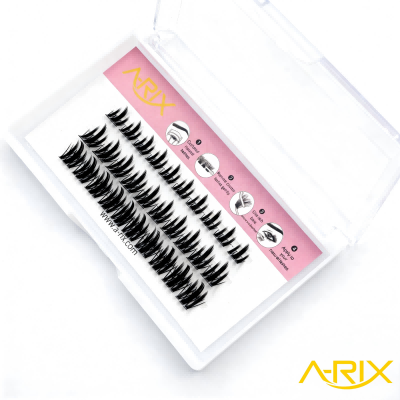

Wholesale problems often hide behind a good sample photo. The second tray may open differently from the first. Dark brown may read as black in normal salon light. A box that looked simple in the brief may carry its own printing minimum.
One mix-up is worth settling at the outset. These are close-set rows of double-layer fans for trained lash artists to lift with tweezers. They are not the cluster segments sold for at-home application. The RFQ, product pictures, and box should all make that distinction.
Teams researching camellia lash extensions wholesale often begin with a reference look. Across the A-RIX lash collection, styling can move from restrained sets to more sculptural directions. A layered fan can serve either mood. What matters to a buyer is less photogenic: will the factory repeat the tray, approved sample, and pack correctly?
Why 5D Multi-Layer Camellia Lashes Fit the Current Market
The shorter fibers bring depth close to the lash line. Longer ones interrupt the top edge, giving an artist room to create anything from soft texture to an emphatic outline.
Arabian-inspired sets show the idea clearly. A-RIX’s Arabian lash mapping guide discusses length contrast, defined peaks, and a lifted outline. Those are application choices. A wholesale buyer has to work backward from the look and decide which physical product will let an artist create it repeatedly.
“Arabian effect” is useful creative shorthand, but it does not tell a factory which lengths to mix, which curl to sample, how the fan should open, or how the tray should be labeled. A short product brief does.
Define the Product Before Requesting a Quote
Confirm the Multi-Layer Fan Structure
Category names are not manufacturing specifications. Two products described as “5D Camellia” can differ in the way their fibers are staggered, the width of the fan, the base, or the length contrast. Ask the supplier to explain the construction and show close photographs of the fan outside the tray.
The current A-RIX product page describes a 5D multi-layer fan with a 2 mm length difference and a double-layer construction. The tray format matters as much as the loose fan. These are dense professional extension rows that an artist works with using lash tweezers. If a supplier presentation shows DIY cluster segments or a full strip intended for direct wear, it is showing a different product category.
During the first review, pull fans from several strips. The short layer should still show, the base should look clean, and density should not drift from one area of the tray to another. Resolve any variation before requesting more curls or colors.
Choose Length Thickness Curl and Color
The A-RIX 5D Camellia product page lists:
- Length: 6–22 mm
- Thickness: 0.05, 0.07, and 0.075 mm
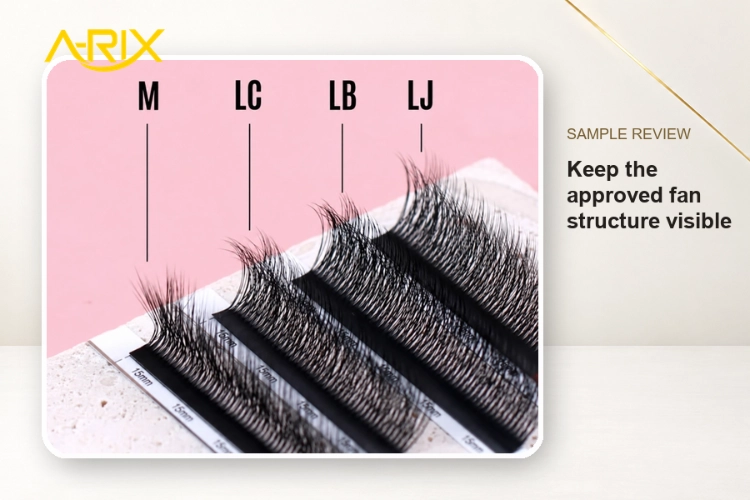
- Curl: J, B, C, C+, D, D+, L, LJ, LB, LC, LD, and M
- Color: black and dark brown
Sampling the entire matrix adds cost without producing a clear answer. Keep most variables still: compare black with dark brown in 0.07 mm, for example, using one curl and length mix. On the next round, hold color and diameter and compare LC with LD. Each box then settles one decision.
Put Private Label Terms Into the RFQ
MOQ and Mixed SKU Orders
Make the quotation concrete. Private label starts at 1,000 boxes, and A-RIX supports mixed SKUs within that quantity. State the count for the lead tray, supporting curls, black, and dark brown, and note whether the variants use one carton design. “Mixed order” by itself is not an allocation.
The lead black mixed tray can carry the photography and demonstrations. Core trays cover routine account demand, while dark brown or a specialist curl can wait for evidence. Every added SKU also needs artwork, a barcode, a web listing, sample stock, a bin, and a forecast. A variant without a distinct buyer job is better left on the development sheet.
Sample Timing and Sealed Approval
A-RIX can normally send the first sample in about seven days after the brief is confirmed. That is a dispatch target, not the whole approval window; allow for transit, artist feedback, and a revision if needed.
Keep a one-page approval record: supplier reference, date, specification, tray layout, pack version, approver, and close photographs. Seal one accepted tray rather than returning every sample to use. A-RIX can retain its match, so both parties compare bulk goods with the same standard.
When the reorder arrives months later, this record answers a basic question that old messages often cannot: which sample was production meant to match?
Packaging Options and MOQ
Packaging also starts at 1,000 boxes. Options include color boxes, blister packs, white cards, and other agreed structures. Choose the structure before approving artwork, then fix the positions of the color, curl, thickness, length format, barcode, and lot information.
Test the proof on a shelf beside similar boxes. The key specification should remain legible without opening the pack.
Evaluate Samples Before a Bulk Order
Check Fan Shape Pickup and Consistency
Take fans from the top, middle, and bottom strips and place them on plain card. Width, symmetry, spacing, and base shape are easier to compare there than inside the tray.
Then try the pickup. Note whether the fan stays open, closes, twists, or separates, along with the tweezer and method used. “Hard to use” gives a development team very little information. “The longer layer shifts when picked up from the left third of the strip” gives them something they can investigate.
Use the same light throughout. Check curl from the side and length alignment from the front. Place black beside dark brown too; the distinction can shrink under a cool salon lamp even when it looked clear in a warm-toned photograph.
An artist trial should mirror the planned service. Record the pickup and placement method, stability, layer visibility, tools, and approximate working time. For an education line or multi-location account, include artists with different working speeds; a problem that an expert quietly works around may be a real training issue for the wider customer base.
Record the Approved Sample for Reorders
Code every development tray and link the accepted code to its label and artwork. If the curl, fiber, strip, tray, label, or carton changes later, issue a new version. Months afterward, the sealed piece is far clearer than “same as last time.”
What to Ask Beyond Unit Price
Find out who turns the brief into the sample, what can be changed, and how revisions are named. When version two arrives, its change note should say exactly what moved from version one.
Generic quality language is difficult to audit. Product-level checks are more useful: fiber arrangement, curl, diameter, fan width, base condition, strip placement, tray code, and final pack. The supplier’s answer should also cover who stops or separates goods when one of those points misses the approved reference.
A-RIX lists lash development, material and color choices, curl and length combinations, pack concepts, printing, and accessories in its OEM and packaging services. The RFQ should assign the work: buyers supply approved brand files and barcode data; the supplier checks dielines, print feasibility, proofs, and assembly.
A Practical RFQ Checklist
- Sales channel and target market
- Intended effect and professional application category
- Required 5D structure and 2 mm length difference
- Length, thickness, curl, and color samples
- Single-length or mixed-length tray layout
- Private-label quantity and SKU allocation
- Sample list, review date, and approval method
- Packaging structure, artwork, barcode, and label fields
- Sealed-sample reference for bulk production
- Target launch date and shipping plan
Compare every supplier against the same brief. A cheaper quote may have omitted the box, variant labels, or a revision round.
Frequently Asked Questions
Is This a DIY Cluster Lash?
No. It is a professional lash-extension product supplied as dense rows of premade double-layer fans. Lash artists pick up the fans with tweezers for professional application.
Can the First Order Mix Several SKUs?
Yes. Within the 1,000-box private-label MOQ, buyers can combine approved SKUs. The allocation still needs to be written out clearly before production.
Conclusion
A photograph may begin the enquiry, but repeatability rests on fan construction, disciplined sampling, a usable pack brief, and one accepted tray kept for reference.
For camellia lash extensions wholesale, that physical approval is what connects a promising first order to a recognizable reorder.