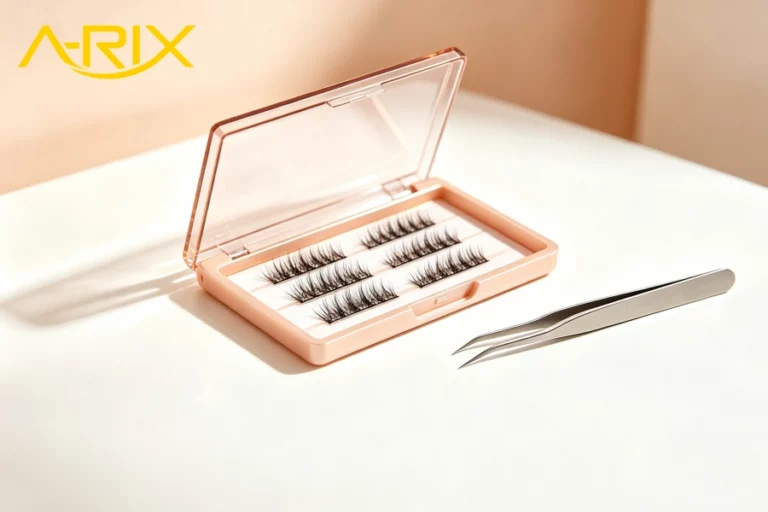
A lot of beginners do not actually struggle with cluster lashes. They struggle with the glue.
You can have a good lash map in mind and still end up with one cluster sliding around while another one has already dried in the wrong place. Then more glue gets added. The base becomes thicker. By the time both eyes are finished, the result may look fine, but the whole process has taken much longer than expected.
That is the main reason pre-glued cluster lashes have become interesting for DIY users. The adhesive is already on the base. No separate glue bottle, no waiting for the right tack, and no guessing whether you used too much.
For beginners, that usually makes the first few applications easier.
Sensitive eyes are another matter. A pre-glued lash still uses adhesive. If your eyes react easily, the label alone does not tell you enough. Lash weight, base thickness, placement and removal can all affect comfort.
If that is your main concern, this guide to lash clusters for sensitive eyes goes deeper into the comfort side of cluster lashes.
So the choice is not really “good product versus bad product.” It is more about what you want to control yourself and how much practice you already have.
What Is the Difference Between Pre-Glued Cluster Lashes and Lash Glue?
The finished lash look can be almost the same.
The difference comes before the lash reaches your eye.
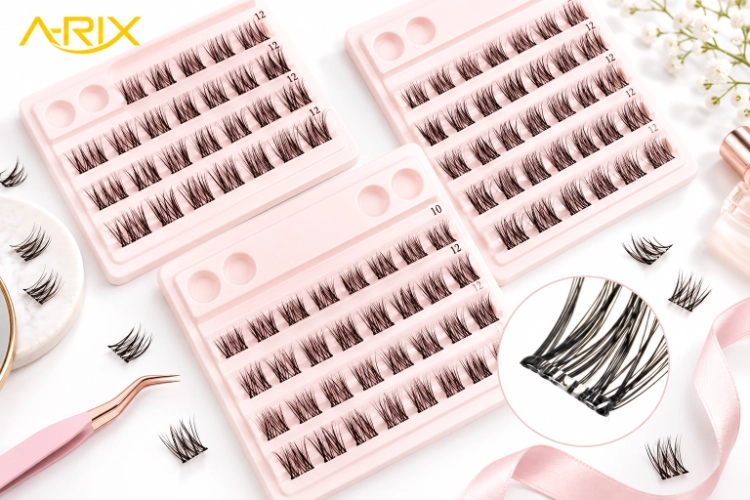
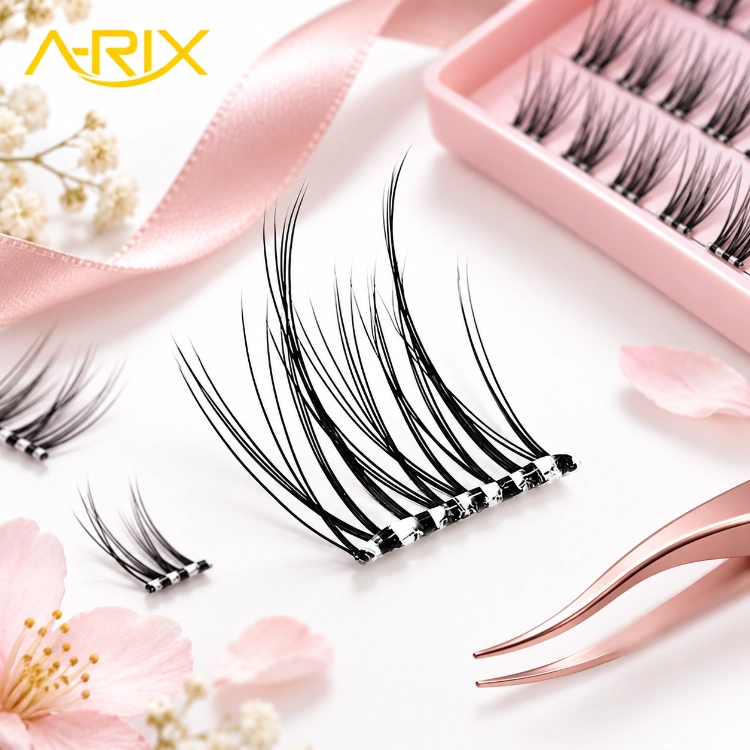
With pre-glued cluster lashes, the adhesive is already on the base. With normal cluster lashes, you add the lash glue yourself.
You can see both DIY and professional lash formats in the A-RIX eyelash product range.
What Are Pre-Glued Cluster Lashes?
Pre-glued cluster lashes are ready to place straight from the tray.
Take out one cluster, position it, press it into place. That is basically the idea.
There is less room for glue-related mistakes because the user is not deciding the amount of adhesive each time. For someone who has never used DIY cluster lashes before, that can save quite a bit of trial and error.
The Pre-glued DIY Cluster Lash Invisible Transparent Pre-bonded Press-on Lash Extension is one example. The cluster format stays the same, but the adhesive has already been applied to the base.
You are still choosing the length, position and lash map yourself. You are simply not dealing with wet glue at the same time.
How Does Lash Glue Change the Application?
Separate lash glue gives you more room to adjust things.
You can decide how much to use. You can use a bond you already know. You can also change the glue depending on your usual wear time or application habit.
That freedom is useful after you have practiced.
At the beginning, it can also be the part that causes the most trouble.
Too much glue leaves a bulky base. Too little can make the cluster move. Put the lash on too soon and it may slide. Wait too long and you lose adjustment time.
None of that sounds difficult on paper. In front of a mirror, with tweezers in one hand and a half-finished lash line, it feels different.
| Factor | Pre-Glued Cluster Lashes | Cluster Lashes With Lash Glue |
|---|---|---|
| Application steps | Fewer | More |
| Learning curve | Lower | Higher |
| Adhesive quantity | Pre-applied | Controlled by user |
| Mess | Usually lower | Depends on technique |
| Placement flexibility | Good | Very high |
| Best suited to | Beginners and fast routines | Experienced DIY users |
| Sensitive-eye suitability | Depends on adhesive and fit | Depends on glue formula and fit |
| Removal | Depends on pre-bond formula | Depends on glue and remover |
Which One Is Easier for Beginners?
Most first-time users will find pre-glued cluster lashes easier.
Not because they are impossible to get wrong. They are not.
You still need to learn placement. You still need to know which lengths suit the inner, middle and outer parts of the eye. A badly placed cluster can still feel uncomfortable.
There is simply one less thing to manage.
Pre-Glued Lashes Cut Out a Lot of Guessing
With lash glue, beginners tend to ask the same questions.
Is that enough glue?
Should I wait another few seconds?
Why is this one not staying in place?
Why does the base suddenly look thick?
Once you have done your lashes many times, those questions disappear. At the start, they slow everything down.
A no-extra-glue, no-mess pre-glued design lets the user spend more attention on the lash map instead.
That makes sense for DIY buyers who want a quicker routine and do not want to learn glue control on day one.
Lash Glue Makes More Sense After Some Practice
There is a reason experienced users still like separate lash glue.
They know how much they want. They know how long they normally wait before placement. Some already have a bond they trust.
That level of control can be useful.
It just is not always useful to a beginner.
If you are still comparing different lash formats as well, the article on cluster lashes vs individual lashes is worth checking. Cluster lashes and individual lashes ask for different levels of control and application time.
More Glue Does Not Fix Bad Placement
This is one mistake worth mentioning because it happens a lot.
A cluster sits at the wrong angle, so the user adds more adhesive.
Usually the result is just a thicker base.
The same thing can happen with pre-glued cluster lashes in a different way. If the cluster feels wrong, pressing it harder will not improve the position.
Take it off and move it.
Placement is still the first thing to fix.
Which Is Better for Sensitive Eyes?
There is no clean yes-or-no answer here.
Pre-glued cluster lashes may be easier to use, but that does not make them automatically better for sensitive eyes.
The adhesive has not disappeared. It is simply already on the lash.
Pay Attention to the Adhesive First
Some users are more comfortable with pre-glued lashes because they are not adding another layer of liquid glue themselves.
That can help if the main problem was over-applying glue.
But if your eyes react to a certain adhesive formula, pre-glued lashes can still cause discomfort.
Anyone who has had a bad reaction before should check the product information carefully and test with more caution.
Redness, swelling, itching or strong watering are not things to ignore just to keep a lash look for a few more hours.
Sometimes the Glue Is Not the Main Problem
A lash can feel uncomfortable even when the adhesive is not causing a reaction.
The base may be too thick. The cluster may be stiff. It may be sitting too close to the waterline. A heavy lash map can also make the eye feel tired after a while.
This is where cluster lashes have an advantage.
You do not have to use the same amount of volume across the whole eye. Use fewer clusters if that feels better. Mix shorter lengths. Leave out a piece instead of filling every gap.
A lighter result often looks better than a lash line that has simply been packed with as many clusters as possible.
Removal Can Cause More Damage Than Wearing Them
People often focus on application and forget about removal.
Then the lashes come off quickly at the end of the day, along with a few natural lashes.
If the cluster is not releasing, do not pull harder.
Loosen the adhesive first. Work close to the base. Give it another moment if needed.
That applies to both pre-glued cluster lashes and lash glue.
What About Wear Time and Lash Mapping?
This part depends much more on the actual adhesive system and the way the lashes are worn.
There is no rule saying lash glue always lasts longer, and there is no rule saying pre-glued cluster lashes always come off faster.
Oil, moisture, lash preparation, placement and daily habits all change wear time.
Someone who uses separate lash glue has more control because they can choose the bond themselves.
A pre-glued product is more fixed. The adhesive is already part of the lash.
Some users like that. They get the same setup each time and do not have to make another product choice.
Others prefer to choose the glue themselves.
Both can make sense.
Lash mapping is similar. Cat-eye, doll-eye, natural and wispy looks can all be built with cluster lashes. Short pieces can go toward the inner corner, with longer ones added where you want more lift or width.
Separate glue does not give you a better lash map by itself.
It only gives you more control over the adhesive.
What Should Lash Brands Check Before Stocking Either Option?
For a brand or wholesaler, I would not start by asking which format is “better.”
Start with the customer.
Is the product being sold to beginners who want a quick DIY set? Or to people who already buy lash bond and know how they like to apply clusters?
Those are different buyers.
Try the Sample, Not Just the Tray
A lash can look excellent in a product photo and still be annoying to use.
Take the sample out of the tray.
See whether the cluster keeps its shape. Check whether it is easy to pick up. Put it on. Remove it. Look at the base after removal.
These basic checks tell you more than staring at the curl in the box.
For a beginner range, easy handling matters a lot. If the first application is frustrating, the customer may not buy the same product again.
Do Not Judge Everything by the Glue
Fiber, thickness, curl, length and base quality still matter.
The adhesive can be good and the lash itself can still be wrong for the market.
Buyers planning a private-label line can go through the A-RIX eyelash catalogs first and narrow down the styles they actually want to test.
The Pre-glued DIY Cluster Lash Invisible Transparent Pre-bonded Press-on Lash Extension also gives room to work with different lengths, curls and thicknesses rather than staying with one fixed look.
That matters if you are building a small range instead of selling one single SKU.
Packaging Should Answer the Obvious Question
Does this lash need extra glue?
The customer should not have to open the box to find out.
If it is pre-glued, say so clearly.
If lash glue is needed, say that clearly too.
This sounds basic, but first-time DIY buyers do get confused about it.
For private-label projects, OEM/ODM eyelash customization services can also cover the product, style, packaging and production side after the sample has been chosen.
Which Option Should You Choose?
If you are completely new to DIY cluster lashes, I would start with pre-glued cluster lashes.
There is less going on during application. You can learn placement first.
Once you know what kind of lash map you like and how you usually wear your lashes, separate lash glue may become more useful because it gives you more control.
Sensitive eyes need a different decision.
Look at the adhesive. Look at the base. Keep the lash light. Do not place the cluster too close to the waterline.
And do not assume one system has to replace the other.
Plenty of users can use pre-glued cluster lashes when they want something quick and use lash glue when they want more control.
That is probably the most practical way to look at the two.
FAQ
Do Pre-Glued Cluster Lashes Need Lash Glue?
Usually no. The adhesive is already on the lash base, so extra lash glue is normally not needed. Check the instructions for the product before use.
Are Pre-Glued Cluster Lashes Better for Beginners?
They are usually easier to start with because the user does not need to manage separate lash glue. Placement still takes some practice.
Are Pre-Glued Lashes Better for Sensitive Eyes?
Not automatically. The pre-applied adhesive can still cause discomfort for some users. Base thickness, lash weight and placement matter as well.
How Long Do Pre-Glued Cluster Lashes Last?
It varies by product and by the way the lashes are worn. Oil, moisture, preparation, placement and daily habits can all change wear time.
Can You Reuse Pre-Glued Cluster Lashes?
Some can be reused if the lash fibers and adhesive base stay in good condition after removal. Follow the product instructions and replace the cluster once the base or lash shape is damaged.