You know what’s funny? Most lash brands spend weeks picking the perfect lash curl, the right band thickness, the ideal fiber blend. And then they spend two minutes picking packaging.
That’s backwards.
Because here’s the thing—your customer doesn’t feel the lash band before they buy. They don’t see the curl up close. All they have is the box. Whether they’re scrolling Amazon or standing at a Sephora shelf, the packaging is the first impression. It’s the thing that makes them stop scrolling, or keep going.
We’ve been making lashes and working with brands on custom packaging for a long time now. Long enough to see the same mistakes over and over. The brands that get packaging right almost always save themselves months of headaches later. The ones that rush it? They’re back at square one after the first run sells out.
This isn’t a “do this, then do that” kind of guide. It’s more like everything we wish someone had told us before we started.
Before you even think about design
I know. You want to talk about finishes. Foil stamping. Embossing. That gorgeous window cutout.
Slow down.
The very first question isn’t “what box looks the best.” It’s “who’s buying these, and where?”
Think about it. A $4 drugstore lash and a $25 luxury lash don’t need the same packaging. One needs to be cheap, durable, and show the product clearly through plastic. The other needs to feel like an experience when you open it. Completely different priorities.
And then there’s the channel. Sold in stores? It needs to stand out on a shelf full of competitors. Sold online? It needs to survive shipping without getting crushed. Sold through salons? The lash tech needs to grab the right style in two seconds flat, no fumbling with magnets or drawers.
Oh, and what’s actually going inside the box? Just one pair of strip lashes? A whole DIY kit with clusters, tweezers, adhesive? Multiple lash styles in one pack?
The answer changes everything. We’ve seen brands design the most beautiful rigid magnetic box you’ve ever seen—for a product that sells for seven bucks a pair. The packaging cost alone eats half their margin. Not worth it.
Figure out the basics first. Then start looking at boxes.
The formats we actually see
There’s no shortage of options out there. But in our experience, about five or six formats cover 90% of what lash brands use.
The most common one is a folding carton with a window. It’s the default for retail strip lashes, and for good reason—shoppers can see the lash shape, the density, the curl right through the plastic. You get the rest of the box for branding. The downside? That window film adds cost, and it makes recycling more complicated. You can’t just throw the whole box in the bin.
Then there’s the plain paperboard box. No window, just print. It’s cheaper, it’s simpler, and it works for wholesale lines or budget brands. It doesn’t feel as premium, sure, but if your price point is under $10, you probably don’t need premium.
Drawer boxes are the step up. You pull the drawer out, there’s a little reveal moment. People love it for gift sets or premium lines. But here’s the catch most brands don’t think about: drawer boxes need extra parts. The outer sleeve, the inner drawer, sometimes a little stopper to keep the drawer from falling out. Assembly takes longer. All of that adds up on your per-unit cost.
Rigid boxes, magnetic closure boxes—those are the luxury end. They feel solid in your hand. They look expensive. But they’re heavy, they take up more storage space, and shipping costs go way up. You’re basically paying to ship air.
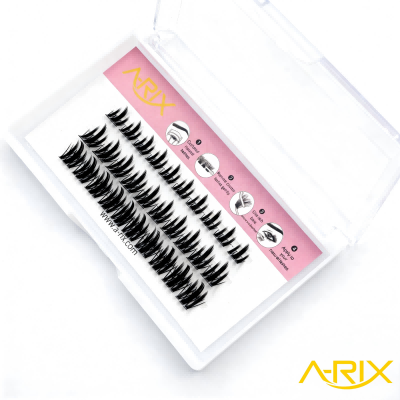
And if you’re doing DIY lash clusters? Forget the outer box for a second. The tray is everything. I mean it. We’ve had brands come to us with a beautiful outer box design, but the tray spacing is wrong—you pull one cluster and three come out with it. That’s how you get returns. That’s how you get bad reviews. The tray design matters more than anything else for cluster products.
Quick way to think about it: strip lashes → window box. DIY clusters → nail the tray first. Professional extensions → you need compartments for different lengths and curls.
What goes on the front of the box
People spend about two seconds judging a lash box. That’s not a lot of time.
So what actually needs to be on the front?
The style name, for starters. Natural, Wispy, Volume, Dramatic. Don’t get too creative here. If someone has to squint to figure out what kind of lash it is, they’ll move on. We’ve seen brands name their lashes things like “Aurora” or “Celestial” or whatever. Sounds pretty. But nobody knows if it’s a natural lash or a dramatic lash.
Then a product photo. Not just a shot of the lashes lying in the tray. Show them on a face. People want to imagine how they’ll look.
Pick one main benefit and put that on the front. Just one. “Reusable 15+ wears.” “Includes adhesive.” “Wispy natural look.” Whatever your strongest selling point is. Don’t cram five different claims onto the front. It’s too much. Nobody reads it. It just looks messy.
And your logo, obviously. Visible, but not so big it takes over the whole box.
Everything else—instructions, ingredients, specs, warranty—goes on the back or the sides. I can’t tell you how many brands try to fit every single selling point on the front panel. It never works.
Oh, and if you have multiple lash styles? Build a system. Use different colors for different categories, or consistent naming conventions. That way people can scan your whole line and find what they want in three seconds.
The part that always bites people
Your box looks great on screen. The mockup is perfect. The colors are right. The logo placement is spot on.
Then the first shipment arrives and half the boxes are dented. Or the tray popped out. Or the lashes are bent.
We’ve seen this happen so many times. It’s almost always the same mistake: brands test the design, but not the packaging itself.
Here’s what you need to test before you approve bulk production.
First, does it actually protect the product? Shake the box. Do the lashes move around inside? Could the lash band survive being tossed around a shipping carton? For clusters, are they held firmly enough that they won’t shift in transit?
Second, can people actually open it? Is it easy to get the lashes out without breaking the tray? For clusters—can you pick up one segment with tweezers without yanking out three more? And where’s the adhesive? Where are the instructions? Easy to find, or buried somewhere?
Third, will it hold up? Does the closure stay closed? Is the window attached properly? Can it survive being handled by warehouse workers, retail staff, and then the customer opening it at home?
Get a physical sample. Then actually test it. Drop it on the floor. Put it in a shipping box with a bunch of other stuff and send it to yourself. Only when it comes through fine do you sign off on the order.
And if you sell online? Don’t forget about secondary packaging. The retail box might be fine on its own, but it needs to fit in a mailer without getting crushed.
## Materials and the sustainability question
Packaging materials affect everything. How it looks, how heavy it is, how much it costs, what people think of your brand.
Paperboard is the default for a reason. It prints well, it’s relatively cheap, it works for almost any format. Clear windows add visibility but introduce plastic, which complicates recycling. Rigid boxes feel premium but use more material and cost more to ship.
Now, sustainability. More and more brands ask us about eco-friendly packaging. That’s a good thing. But here’s the thing you need to know: you can’t just swap out one material and call yourself “plastic-free.”
If sustainability is part of your brand, you need to look at the whole package, not just the outer box. Ask your supplier what the inner tray is made of. Ask if different materials can be separated for recycling. Ask what recycled or molded fiber options they have. And ask what evidence they have for any recyclability claims.
One thing we see all the time: brands slap “100% recyclable” on their box, but then there’s a PET window and some hot glue that nobody can separate. That’s not recyclable. That’s just wishful thinking. Be specific. “Made with 70% post-consumer recycled paperboard” is way better than vague buzzwords.
And don’t forget about total cost. I know I mentioned this earlier, but it’s worth repeating. Your per-unit price isn’t the real cost. There’s printing, tooling fees, inserts, assembly, minimum order quantities, and shipping. A box that’s ten cents cheaper per unit might actually cost you more overall if it needs extra components or makes your shipping carton bigger.
Two brands that got it right
Let me tell you about two brands we’ve watched closely recently. They solved two different packaging problems, and both are worth learning from.
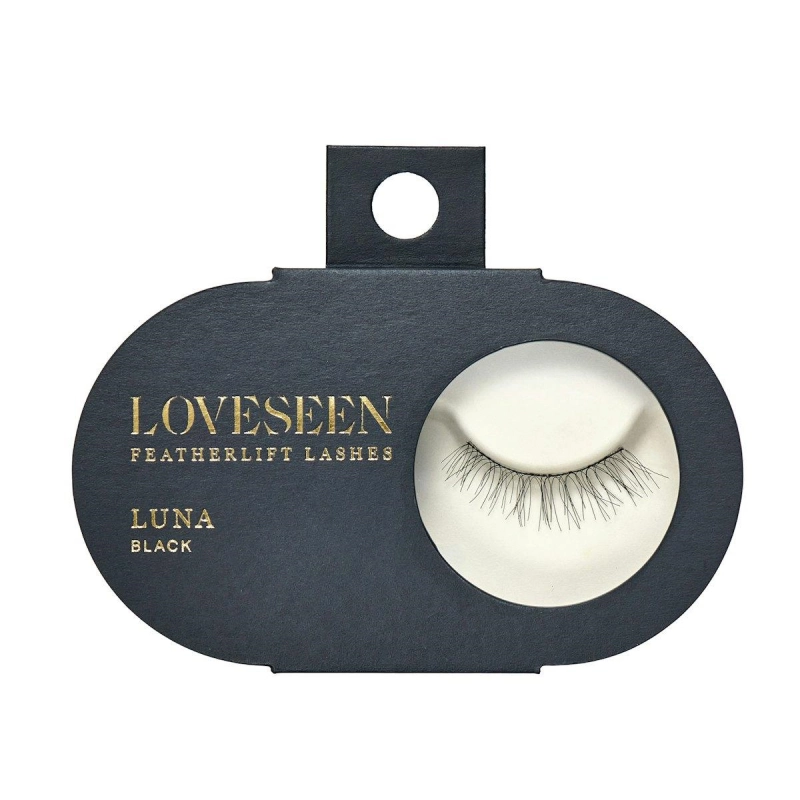
First up: Loveseen. They worked with Innovative Beauty Group to redesign their packaging. The goal was simple: cut way down on plastic, but still keep that shelf presence.
What they came up with was reportedly 98% plastic-free. The inner tray is molded sugarcane pulp—you might have heard it called bagasse. The outer box is post-consumer recycled paperboard. They kept one clear PET window so shoppers can still see the lashes.
They also skipped glossy and metallic inks, which helps with recyclability. Though, fair warning—you do have to remove that PET window first before recycling, and local rules vary.
The project started with 12 lash styles. Later they expanded to 14. Getting there took multiple rounds of sampling and redesign. Which makes sense, right? When you’re building a packaging system that has to work across multiple products, you can’t get it perfect on the first try.
The big takeaway for us: sustainability isn’t just about changing the outer box material. It’s about the whole structure. And yeah, there are trade-offs. You can’t have a fully clear window and be fully plastic-free at the same time. You have to pick your priorities.
Source: https://www.packworld.com/leaders-new/business-drivers-specialty/sustainability/article/22644640/loveseen-launches-sustainable-false-lash-packaging
The second one is TAD Beauty. Back in March 2025, they updated the packaging for their DIY lash cluster line.
Their original design used a scaffolding-style setup. It looked really cool—it showed off the 3D lashes beautifully. But customers kept saying the clusters were hard to get to. Like, you’d dig around trying to find the right segment, and you’d pull out three others by accident.
So they redesigned it with a pick-and-pull arrangement. You grab the segment you need directly, no digging.
And here’s the thing: the lashes themselves didn’t change at all. This was purely a packaging and usability redesign.
Why does this matter? Because it’s a reminder that a cool-looking design isn’t always the most practical one. How the clusters are arranged, how easy they are to grab—that stuff matters just as much as the outer box design. More, honestly.
Customer feedback will tell you things that a design mockup never will. You can look at a render all day long, but you won’t know if the tray actually works until someone tries to use it.
If you’re doing DIY lashes, do this test before you finalize anything: hand the sample to someone who’s never used the product. Can they pick up one cluster cleanly? If they can’t, your tray design needs work. Simple as that.
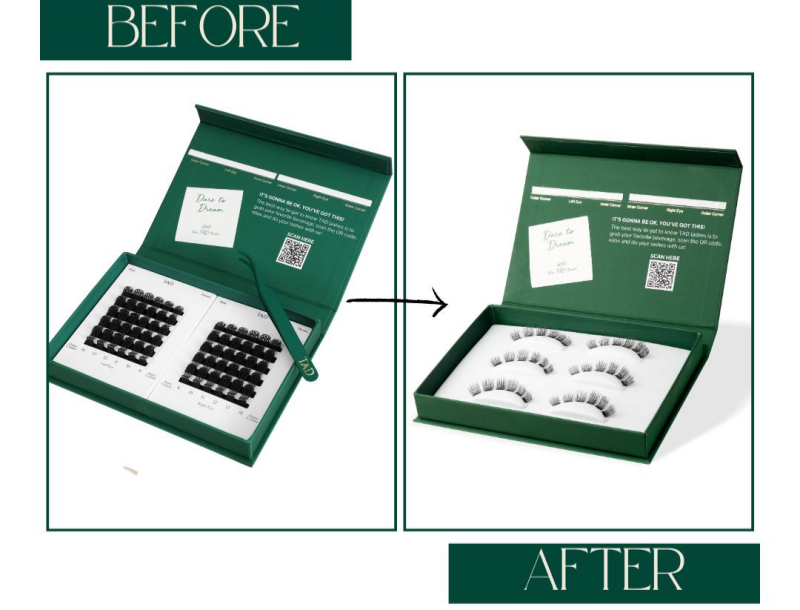
Source: https://tadbeauty.com/blogs/news/tad-beauty-new-packaging
Before you place that order
Okay, so you’ve picked your box style, you’ve got the design nailed down, you’ve talked to your supplier. Before you pull the trigger on a bulk order, run through this quick list:
Does the packaging actually match your brand? And is it right for where you’re selling—stores, online, salons?
Can customers easily tell what lash style it is? And can they see the key product info at a glance?
Does the tray protect the lashes? And can people actually get them out without breaking anything?
Have you signed off on all the printing, colors, logo placement, and artwork?
Have you checked every single material, insert, accessory, and closure?
Did you actually test the packaging in real conditions? Dropped it? Shipped it? Handled it?
Are any sustainability claims you’re making actually backed up by evidence?
Have you looked at the full cost picture—unit price, tooling, MOQ, assembly, shipping? Not just the per-unit number.
Does your manufacturer have documented specs for the approved design?
And keep a reference sample on file. Both you and your supplier need something to compare against when production starts. Trust us on this. It saves so many arguments later.
Wrapping up
At the end of the day, there’s no perfect packaging solution. It’s always a trade-off. Between how your brand looks, how well the product survives shipping, how easy it is for customers to use, and what it costs.
The fanciest, most expensive box isn’t automatically the best one. The best one is the one that fits your product, your customer, and your price point.
Loveseen went the sustainability route. TAD Beauty went the usability route. Different problems, different solutions. But both started by asking the same question: what do our customers actually need?
If you’re working on a new lash line, talk through the packaging structure, materials, and testing requirements with your manufacturer before you commit to a bulk order. It’ll save you time, money, and a lot of headaches later.
At A-RIX, we help lash brands with everything from style development to custom packaging and OEM/ODM production. If you want to talk through what might work for your next collection, drop us a line. We’re happy to walk through options with you.