Eyelash Curl Chart: C, D, L, LC and LD Curls Explained for Brand Buyers
Every week a sample request lands in our inbox that reads something like: “C curl, D curl, and that L one — send a bit of everything.”
Fine. We can do that. But three weeks later, the same buyer emails back asking why their launch photo looks nothing like the brand they’re copying. Nine times out of ten, the problem wasn’t the lash. It was the curl they picked without ever really looking at one.
So let’s put the whole curl thing on one table. I work on the production floor here at A-RIX, and this is the chart I wish every first-time buyer had before writing their first purchase order.
Why curl matters more than you think
Thickness and length are the easy parameters. Everybody gets those. Curl is the quiet one that changes the whole personality of a lash — how open the eye looks, whether the tip points up or down, even how the lash photographs under ring lights.
Here’s the part buyers forget: curl is a number, but it reads differently on every eye. A D curl on a client with hooded lids can look dramatic. On a client with deep-set eyes and a low brow bone, that same D curl can poke the lid or point straight down. Same tray, two totally different reviews.
That’s why we don’t really sell “the best curl.” We sell the curl that fits your market.
The chart: C, D, L, LC and LD at a glance
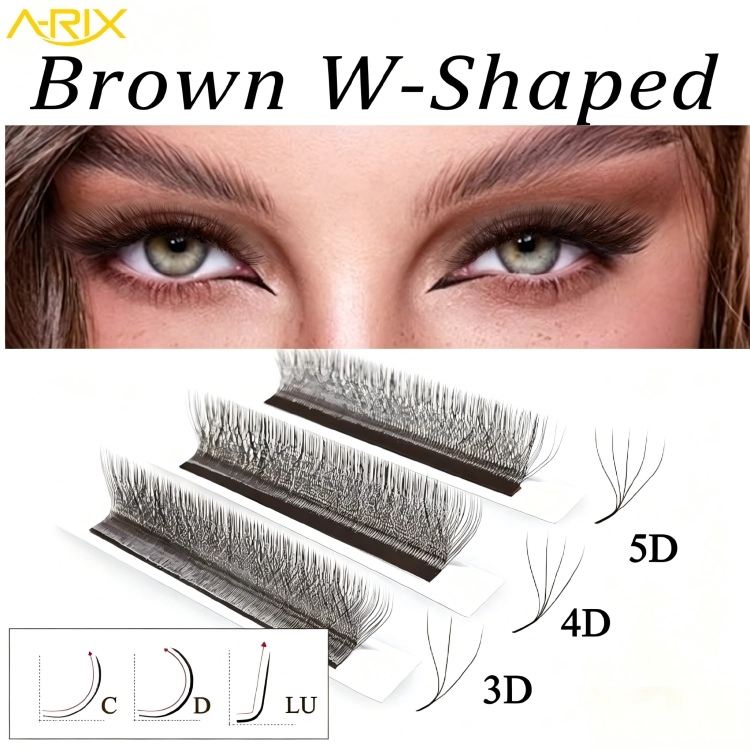
Think of curl as how many degrees the lash lifts away from the flat band. Rough numbers, measured the way our QC team measures them:
| Curl | Approx. lift | Reads as | Works for |
| J | ~30° | barely lifted | very natural, straight-lash markets |
| B | ~40° | soft lift | daily wear, mature clients |
| C | ~60° | open but soft | the safest volume seller |
| D | ~80° | lifted, showy | volume sets, photos, events |
| L / L+ | ~90°+ | lifts from the base | hooded or downturned eyes |
| LC | between C and L | flat base, C-tip | hooded eyes wanting soft glam |
| LD | between L and D | flat base, D-tip | hooded eyes wanting drama |
Now the long version, curl by curl.
C curl: the one you’ll never have too many of
C is roughly a 60-degree lift. Not shy, not loud. It opens the eye enough to read “done” in a photo but stays believable in person.
If you’re building a first lash collection and you can only stock one curl, this is it. In our own numbers, C curl still moves the most volume trays of anything we ship — hybrid sets, natural sets, camellia trays, all of it. Retailers in Germany and the UK reorder C-heavy mixes constantly. It’s the safe bet that almost never sits on a shelf.
D curl: for the photo and the event
D lifts around 80 degrees. The tips point noticeably upward, the eye looks rounder and more awake, and volume fans in D catch light beautifully. Russian volume and mega-volume artists mostly live here.
The catch: D reads “makeup” instantly. If your brand voice is clean girl, minimal, no-makeup makeup — a D-forward catalog will fight your own positioning. And on hooded or downturned eyes, a full D set can tip over into spidery fast, especially at 0.05 thickness with tight fans.
One more thing we see at exhibitions: D trays photograph darker than C. Same black fiber, but the tighter angle stacks more shadow. Warn your photographer before the shoot, not after.
L and L+: the base does the work
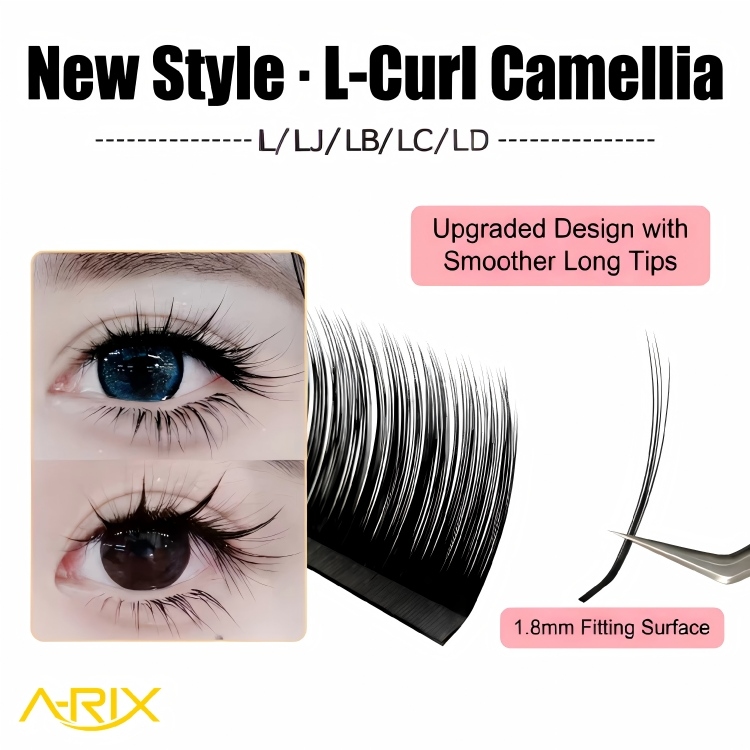
L curl looks odd on a tray — almost flat for the first half, then a sharp lift near the tip. That flat base is the whole point. On a hooded eye or a client whose lid sits low over the lash line, a C or D base buries itself under the lid fold. The client walks out, looks in the car mirror, and sees nothing. That’s a refund waiting to happen.
L curl starts *above* the fold, so the visible part of the lash is nearly all lift. L+ pushes the angle even harder for clients who want drama without the base disappearing.
Our L-curl wet camellia trays have done well in exactly this niche — manga-style, fox-eye, that whole wet-look direction — because the flat base holds the spacing that makes those styles readable.
LC and LD: the compromise curls, and honestly often the best answer
LC sits between L and C: flat-ish base, C-angle tip. LD is the same idea with a D tip.
Think of them as L curls with a friendlier personality. The flat base still clears a hooded lid, but the tip angle is softer than a full L, so the set blends with natural lashes instead of shouting over them. LC is probably the single most requested curl we’ve had from salons serving clients over 35 — mature lids, softer looks, still wants *something*.
If your customer base includes a real mix of eye shapes, an LC/LD line covers more of them than a pure C/D line does. Fewer refunds, fewer “it doesn’t suit me” reviews.
How to actually brief a curl to a supplier
Here’s where sample rounds go wrong, so let me save you the email chain. “C curl” alone is not a spec. Two factories, both shipping “C,” can be 10 degrees apart, and nobody is lying.
When you request samples, put four things on one line:
- Curl letter— C, D, L, LC, LD.
- Thickness— 0.05, 0.07, 0.10 and so on.
- Length mix— a tray of single 10mm tells you almost nothing. Ask for a mixed tray, say 8–14mm.
- What it’s for— “retail strip lash,” “salon volume,” “DIY cluster” are different animals. A curl that works as an extension can look dead as a strip lash, because strip lashes get no help from a natural lash underneath.
Then do one thing most buyers skip: tape the samples to your own eye (or an intern’s — we use ours) and take a photo straight-on and at 45 degrees. Product shots from suppliers are shot from the angle that flatters the curl. Yours will be shot by your customers, from whatever angle they happen to be.
Common curl mistakes we see on the factory floor
- All-D catalogs.Brands chase the drama look, launch, then quietly re-order C three months later. Start C-heavy, keep D as the accent.
- Ignoring L/LC entirely.If your market has any meaningful share of hooded or mature eyes — most Western markets do — you’re leaving money on the table.
- Matching curl to trend audio.Fox-eye, doe-eye, manga — those are *mappings* (which curls in which zones), not single curls. A fox-eye set is usually L or LC in the inner corner flowing to D at the outer. Brief the mapping, not the hashtag.
- Assuming curl survives everything.Heat in shipping containers, aggressive steaming during application, and cheap polyester fiber all relax curl over time. This is one reason we run PBT fiber on extension lines — it holds its memory far better through a 30-day sea freight to Rotterdam.
FAQ
Q: Which curl sells best for a new lash brand?
C, without hesitation. It fits the widest range of faces and positions. Add D for volume SKUs and LC for hooded-eye customers once you see what your market asks for.
Q: Is LC curl the same as L curl?
No. L is flat at the base with a strong lift. LC has a flatter base than C but a softer tip than L. LC reads more natural; L reads more lifted.
Q: Do curls differ between strip lashes and extensions?
They can. A D curl strip lash needs a slightly gentler angle than a D extension because there’s no natural lash supporting it. We usually recommend buyers sample the same letter in both formats before locking a spec sheet.
Q: How do I test whether a curl will hold through shipping?
Ask the factory for the fiber type and the curl-setting process, then request samples from an actual production batch — not hand-made showroom samples. Store them two weeks in a warm box before evaluating. That simulates freight better than any spec sheet.
Curl looks like the smallest line on a spec sheet. It isn’t. It decides who your lash suits, how it photographs, and whether your first reviews say “obsessed” or “dropped.”
Get samples of C, D, L, LC and LD in one mixed round, test them on real eyes, and write your curl chart from what you see — not from another brand’s product page. If you want a starting point, our team can put together a curl sampler across our eyelash extension and DIY cluster lash lines so you can compare on one table. It’s the fastest sample round you’ll ever run.