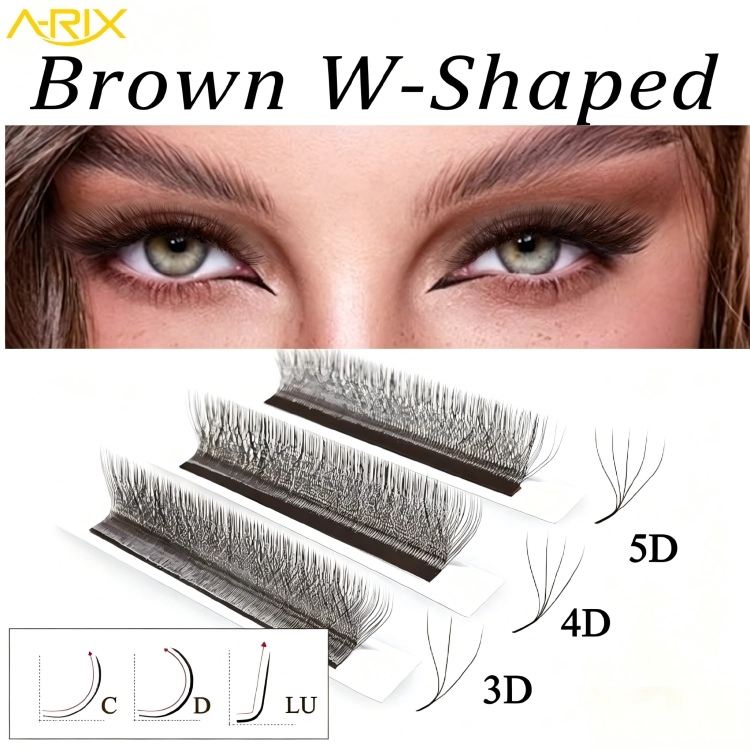
Last month a buyer sent us two quotes she’d collected for the same tray: C curl, 0.07, clusters from 10 to 16 mm, clear case. One supplier came in around a dollar a tray. The other quoted three times that. Her question was short and fair: “Can you match the first one?”
We couldn’t, and we told her so. But the honest part of the answer isn’t about our price. It’s that neither number was wrong. They just weren’t quoting the same tray.
If you buy DIY cluster lashes at wholesale, the price per tray is the least informative line on the whole sheet. Here’s what we see when we read a competitor’s quote, and what we’d want buyers to check in ours.
1. What actually sits inside a tray price
Five things, roughly in this order of impact.
The fiber. Most decent cluster lashes start with PBT, the same matte, soft synthetic that holds a set curl and doesn’t glare under flash. Cheaper trays lean on polyester blends that look fine in the listing photo and go shiny and stiff after a few wears. The fiber is usually the biggest single cost driver, and it’s invisible once the lashes are in a case.
The band. This is where cluster products really separate. A bonded, knot-free base that runs about 0.05 mm or thinner sits flat against the lid and disappears in daylight. A thicker molded or strip-glued base costs less to make, and it shows: a visible black ridge at the lash line, or a base that cracks when the wearer bends a cluster to adjust it. Our 3D printed, laser cut line exists mostly because band thickness turned out to be the thing wearers noticed first, even before curl or length.
The base work. Hand-tied and heat-bonded fans cost more per cluster than machine strip-cutting. The labor sits in the root: how tightly the fibers converge, whether the base holds its shape when a wearer pulls a cluster off with tweezers and re-positions it. Strip-cut clusters shed from the root far more often, and shedding is the number one complaint we hear about cheap trays.
Count and fill. “12 rows” on a spec sheet can mean twelve full rows or eight full rows with two sparse ones at each end. Clusters per row varies too. A tray with 96 evenly spaced segments and a tray with 78 vary in fill long before anyone counts them.
Yield. The quiet one. A tray line running at a 94% first-pass rate costs more to operate than one at 80%, and neither supplier writes that on the quote. The difference doesn’t show on the invoice. It shows later, in returns.
2. Why the cheap tray wins the PO and loses the reorder
Here’s the arithmetic that doesn’t get done.
A tray that saves you $0.60 at the unit price feels like a win on a 2,000-tray order. That’s $1,200 kept. Now suppose the defect rate runs a few points higher and the base adhesive lets go in transit through a humid summer. You’re fielding customer service tickets, pulling stock, and paying for a partial re-shipment. One re-run plus freight can erase that saving and then some.
The better frame is cost per wear, or even cost per reorder. A tray that survives the tweezers test, holds its curl in a hot mailbox, and doesn’t shed at the root is cheaper over the life of your brand, even at a higher unit price. We’ve had clients switch back after a season with a cheaper source, and the switch-back order always costs more than the money they saved. That’s not a sales line. It’s just how the year went.
3. The spec gaps that make quotes impossible to compare
Most quote mismatches aren’t dishonesty. They’re underspecification. A PO line that reads “C curl, 0.07, 10-16 mm, black” pins down fiber diameter and curl, and leaves the expensive questions open.
Before you ask three factories for the same quote, pin these down:
- Band thickness in millimeters, and how the base is formed (bonded, molded, laser cut)
- Curl tolerance. “C curl” from one factory can be another’s C+ or D minus. Ask for the tolerance range, not the letter
- Pre-glued or glue-free. If pre-glued, which adhesive class, cure time, and shelf life
- Row length in mm, clusters per row, and segments per cluster
- Whether lengths within the tray are blended or graduated, and where the longest cluster sits
- Tray dimensions and whether the counts quoted are per tray or per case
We keep a sample approval checklist for exactly this reason, and it applies to cluster products just as much as to extensions. Two quotes against a written spec will usually land within 20 or 30 percent of each other. Two quotes against a sentence will land anywhere.
4. A quick way to normalize two quotes
Once the spec is pinned, put the quotes side by side and divide price by delivered value per tray, not per unit. A simple sheet looks like this:
Table 1 · Side-by-side reading of two cluster lash quotes
| Line | Quote A | Quote B | Why it matters |
| Price per tray (FOB) | $1.10 | $3.40 | The number everyone compares |
| Band thickness | not stated | 0.05 mm, laser cut | Comfort, visibility, repositioning |
| Base type | strip-glued | heat-bonded | Root shedding, tweezer handling |
| Rows / clusters per row | “12 rows” | 12 rows, 96 segments | Actual fill per tray |
| Pre-glued | no | optional, medical-grade PSA | Assembly time for end users |
| First-pass yield | not stated | ~94%, QC per pallet | Your future return rate |
| Sample from production line | showroom only | line-direct | Whether the quote matches reality |
The blanks are the point. Every line a supplier leaves unstated is a line where they’ve chosen the cheapest option for you.
5. Where MOQ and packaging bend the math
Two more variables that buyers often treat as afterthoughts.
MOQ. A 50-tray run costs more per tray than a 1,000-tray run, and the gap is mostly setup: material changeover, machine calibration, first-article checks. If a supplier quotes a surprisingly low price at a tiny MOQ, assume something in the spec got simplified. We publish our standard process including the sample confirmation stage, because a quote without a sample approval step in front of it is a quote you’re taking on faith.
Packaging. For retail-ready DIY kits, the clear injection case, insert card, and branding can run 15 to 30% of the landed cost of the product inside it. Magnetic closures and eco materials push that higher, and EU retail channels increasingly ask for the eco option. Worth deciding deliberately: a promo SKU can ship in a basic case; your hero SKU probably shouldn’t.
6. Five questions to ask before you sign
- What is the band thickness in millimeters, and how is the base formed?
- What’s the first-pass yield at final QC, and who pays for a re-run if a batch fails?
- Is the curl heat-set before or after cutting, and what retention do you guarantee through shipping?
- If pre-glued: which adhesive, what shelf life, and how does it behave after six months in a warehouse?
- Can I get three trays sampled from the actual production run, not from the showroom drawer?
Any factory that answers those five plainly is probably a factory you can work with, whatever their price turns out to be.
One last thing
We don’t win every quote, and we’ve stopped worrying about it. Some buyers genuinely need the cheapest tray on the market for a giveaway SKU, and that’s a legitimate choice, as long as it’s made on purpose rather than by accident. The trouble starts when a $1.10 tray gets compared against a $3.40 tray as if they were the same object with different price tags. They almost never are.
If you’re collecting quotes for a DIY cluster line this quarter, send us your spec sheet and we’ll mark up the ambiguous lines before you commit. It costs you nothing, and it’s usually more useful than another price.
Frequently asked questions
Why do DIY cluster lash prices vary so much between suppliers?
Fiber grade, band construction, bonding method, actual fill per tray, and factory yield account for most of the spread. Quotes given against an incomplete spec can differ by a factor of three while both suppliers describe their own offer accurately.
What MOQ should I expect for private label cluster lashes?
Small brands can usually start around 50 to 100 trays per style with semi-custom packaging. Price breaks typically appear at 500 and 1,000 trays, driven mostly by setup time and packaging runs.
How do I compare two cluster lash quotes fairly?
Fix the spec first: band thickness, base type, curl tolerance, row fill, pre-glue status. Then compare price per tray against the same written spec, and ask each supplier to state their yield and sample policy in writing.
Does pre-glued cost more than glue-free?
Usually yes, because of the adhesive application and controlled curing step, plus shorter shelf life handling. It trades a higher unit cost for faster assembly for the end wearer, which many DIY customers will pay for.