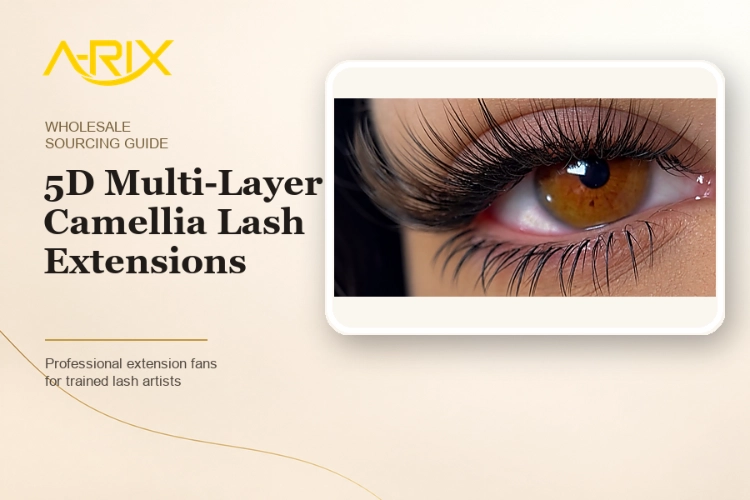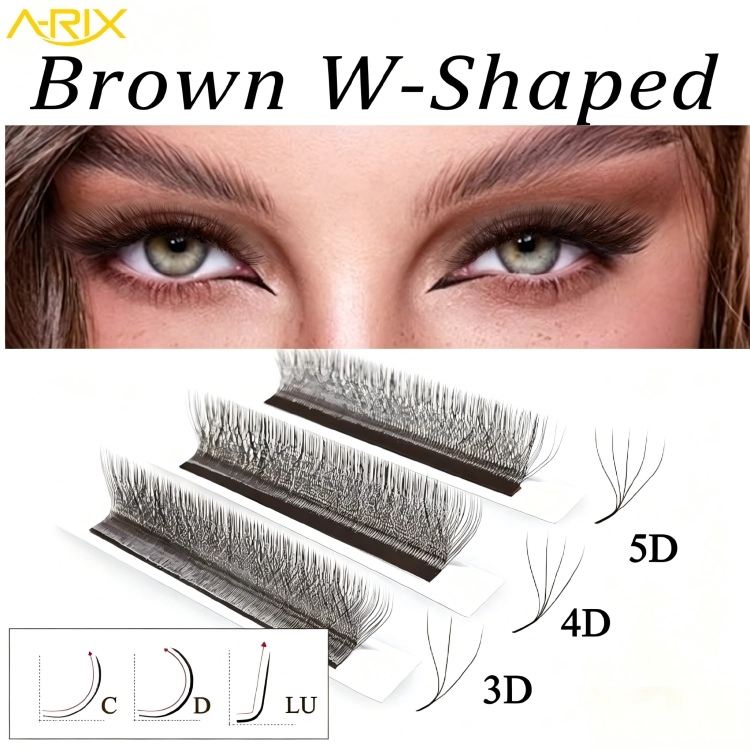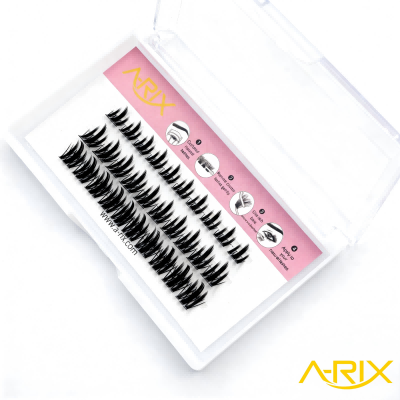

Picture a representative opening a sample case at a salon group meeting. The tray looks good, yet the first question is unexpectedly basic: “Is this for professional extension work or home application?” The rep reaches for the line sheet, while the website calls the style Arabian and the box says only Camellia. Three materials, three different explanations.
This is where a technically approved product can lose momentum. With 5D Camellia lash extensions, the sales story has to begin with the object itself: premade professional fans in dense rows, built in two layers with a 2 mm length difference. They are lifted with tweezers for extension services. They are not DIY cluster segments.
The sales case now has a narrower purpose than a catalogue: show what was approved, and make the next question specific enough for the product team to answer.
Give the Product One Stable Identity
Put Construction Before the Trend Name
“Arabian effect” belongs under styling ideas, not in place of the product definition. Write the physical description first: professional 5D Camellia premade fans, dense tray rows, two fiber layers, 2 mm apart. A salon can then discuss wispy volume, textured peaks, or a stronger cat-eye without mistaking one map for the product itself.
The Camellia product page provides the technical boundaries. Its range covers 6–22 mm, 0.05, 0.07 and 0.075 mm, several curls, and black or dark brown. The distributor’s launch sheet should show the subset that has actually been approved, not the whole menu of possible production choices.
Pass the sheet to someone who missed the development meeting. If the reply is “a dramatic cluster lash,” the styling copy has swallowed the category. Fix that before adding more claims.
Use Three Pictures With Three Different Jobs
One finished-eye photograph cannot carry the entire explanation. It shows a look, but not the fan base, the layers, or the tray format. Build the image set in a sequence.
Use a loose fan first, the labeled tray second, and one approved application direction third. Shoot black and dark brown under the same light. Otherwise the photographer, rather than the fiber, may create the apparent color gap.
That sequence also works on a wholesale page. The wider A-RIX product catalog helps buyers see neighboring families, while the specific listing should make the Camellia construction recognizable without a catalogue tour.
Make the Sample Case Useful in the Field
Let the Case Answer the First Thirty Seconds
Pack the lead SKU, a few supporting versions, loose fans, and the finished box. Then put the case on a small counter and try it standing up, as a rep often will. Dark brown should be easy to find without reading every label. The professional fan rows should be obvious before anyone reaches for a brochure.
For color or curl comparisons, keep everything else matched. Black and dark brown should share the same curl, thickness and length mix. Two curls should be shown in the same color. A comparison that changes four variables at once gives the rep plenty to point at and very little to explain.
Keep One Working Product Card
Use one working record across sales, ecommerce, training, and customer service. For each live SKU, note:
- Internal code and product family
- Professional application category
- Fan construction and layer difference
- Color, curl, thickness, and length format
- Tray layout and strip count
- Pack and label version
- Approved sample code and date
This is not the factory development file. Possible colors, experimental curls, and abandoned layouts belong elsewhere. A rep looking at the working card should know what can be sampled or ordered today.
The distinction matters during a launch. A customer may ask for an LC curl after seeing it on a general option list. If LC is not part of the approved assortment, the accurate answer is “we can review that for development,” not a casual promise that it is already part of the range.
Change the Depth Not the Facts
A field rep needs a quick physical comparison; ecommerce needs exact filters and close images; an academy may need pickup notes. The depth changes. The SKU identity does not. When a field changes, date the new material and remove the old file, or last month’s label will keep circulating after the revised carton reaches the warehouse.
Train Representatives Around the Tray
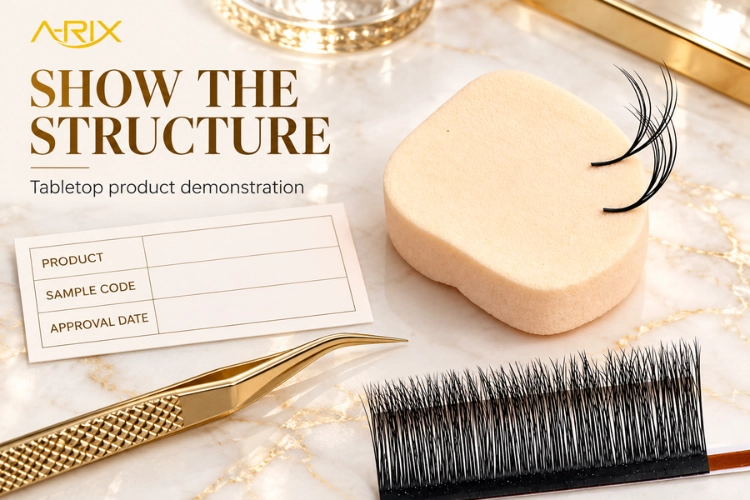
Use a Tabletop Demonstration
For the first demonstration, skip the eye model. Pull one fan from an upper strip, one from the middle, and one from the bottom. Place them on white card beside the labeled tray. The buyer can see the layers and base, then watch what happens at pickup.
An observation travels better than an adjective. “Both levels remain visible after pickup” records what happened. “Super fluffy and lightweight” depends on personal judgment and may promise more than the demonstration showed.
During practice, one rep may call the tray a cluster, another may guarantee the reference look, and another may never mention the 2 mm difference. Those are factual misses. Correct them without scripting every sentence.
Write Down the Questions That Keep Returning
Early conversations tend to return to the same points: professional or DIY, Camellia versus equal-length fan, the live specifications, mixed-SKU ordering, and the chosen pack. Keep the approved answers behind the card.
Do not force an answer when the question belongs with production. A request for a new curl, a different strip, or revised tray layout is a development note. Mark it with the customer, market, current SKU and intended use. That record is far more useful than a message saying, “They want another version.”
Connect the Toolkit to the Private Label Plan
Show the Range That Is Actually Being Made
A-RIX starts private-label work at 1,000 boxes and allows approved SKUs to be mixed. If black carries most of the order while dark brown and two extra curls support it, the sample case should look that way too.
Giving every variant equal space makes the launch look broader than the stock plan. Put the best sample and strongest images behind the lead tray. Keep a supporting SKU when a salon can name the job it performs; otherwise it adds a barcode, bin, listing, and forecast without adding a reason to buy.
Once the brief is fixed, the first sample can normally be sent in about seven days. Transit, review, and a possible revision sit outside that week. Seal one approved tray for the production reference; do not let it disappear into the demo case.
Match the Pack to the Card
A-RIX offers color boxes, blister packs, white cards, and other agreed formats; the packaging MOQ is 1,000 boxes. Browse the packaging range for options, then record the chosen structure and artwork version on the working card.
Take one closed-pack image and one with the tray exposed. Compare both with the production sample. A moved label or revised window is enough to make yesterday’s training slide misleading.
The published OEM support covers lash development, printing, accessories, and packaging. Inside the project, put a name beside each approval—sample, artwork, barcode, pack proof, and final sales files. “Marketing will handle it” leaves no owner.
Bring Field Notes Back to the Reorder
Use three tags for early feedback: product question, missing asset, and SKU request. A repeated product question points to weak copy or training. A missing asset might be a brown-versus-black photograph. A SKU request belongs in the range review and needs context before it changes the order.
Attach the SKU and sample code to every note. Slow sell-through then has two possible conversations: the tray may be wrong for the range, or the field team may never have received a persuasive sample.
FAQs
Q1: What belongs in a distributor sample case?
A1: Use the lead tray, selected supporting SKUs, loose-fan examples, one working product card, any necessary color or curl comparison, and the approved pack. Every item should use the order code.
Q2: Should the card list every factory option?
A2: List the approved launch range. Keep other possibilities in the development file so an experimental curl or color is not presented as stock.
Q3: When is a new toolkit version needed?
A3: Issue one when the sample, SKU mix, label, pack, or imagery changes. Review repeated field questions at the same time.
Conclusion
A good case makes sense before the rep begins a long explanation. Its tray, fan card, live SKU list, and finished pack agree.
For 5D Camellia lash extensions, the fixed point is the professional dense-row, layered-fan construction. Give the lead tray enough room and send field notes back with a code and context. That is far more useful at reorder time than another folder of general launch copy.