A sample tray can look attractive while the assortment behind it is impossible to manage. One kit uses C curl at 10, 12, and 14 mm. Another begins at 8 mm, changes to D curl, and uses a different band. The names suggest a coordinated collection, yet your retailer cannot explain how a customer should move from one kit to the next.
For a private-label DIY cluster lash kit, build the product matrix before you finalize artwork. The matrix gives your team one controlled view of curl, length, density, band, tray position, and intended look. It also turns “make it more natural” into a sample revision that a supplier can follow.
Start With Three Looks Your Customer Can Distinguish
Choose three approved reference looks rather than every option in a catalogue. You might begin with a short everyday map, a graduated outer-lift map, and a fuller map. The exact choices belong to your target customer, price point, and sales channel.
For each look, record the cluster position from inner to outer eye, the length in every position, curl, fibre thickness, band colour, and the number of clusters used. Add a front and side photograph under the same lighting. A beauty photograph without a map is difficult to reproduce; a map without a photograph can hide how the finished graduation actually reads.
A-RIX’s classic natural cluster lash page lists a broad selection of lengths, curls, and thicknesses for that product. Treat those as available discussion points for the cited item, not a requirement to place every combination in one launch.
Make Every Row Answer a Shopper Question
Give each matrix row a clear job. “Short daily definition” is more useful than “Style A.” “Graduated outer lift” tells a retailer how the second kit differs. If two rows use the same map and only the marketing name changes, you probably have duplication rather than a useful assortment.
Read the length steps horizontally. If the first look ends at 12 mm and the next begins at 14 mm, decide whether that jump is deliberate. Read the curls vertically. If two kits use different curls but the same nominal length, remember that a stronger curl can appear shorter from the front.
Your matrix should not promise that one map fits every eye. It records the intended arrangement for the product. Packaging can show a suggested pattern while allowing an adult user to adjust placement according to the product instructions.
Review Curl and Length Together
Mount labelled clusters from the proposed kits on one sample board. Photograph the board from the front and side with a scale or grid in the frame. Keep the sample code visible.
This simple comparison reveals differences that separate campaign photographs can hide. You can see whether a D curl changes the apparent length, whether two rows overlap visually, and whether the outer transition looks abrupt. If your project mixes curls in one tray, record the exact cavity for each curl. “Mixed curl” is not a production instruction.
The A-RIX segment cluster page also shows that band and curl choices may vary by product. Keep the chosen sample and its controlled specification together so a general catalogue description cannot overwrite it.
Put the Band in the Same Matrix
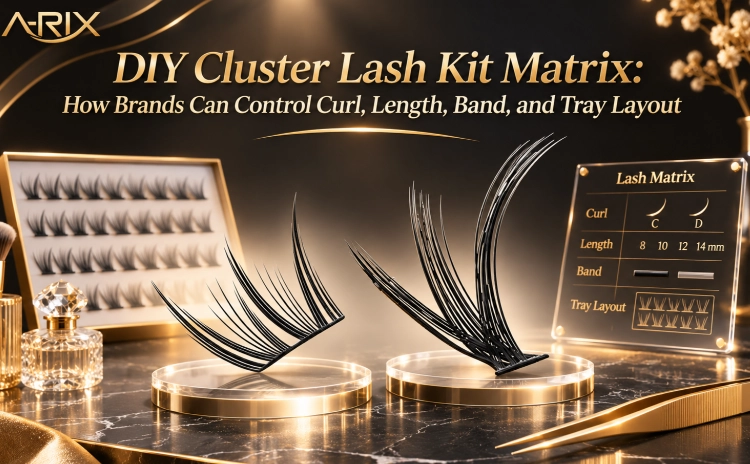
The band affects how a cluster looks in the tray, how it is picked up, and how the root appears. Record band colour, width or approved reference, profile, and placement orientation beside the fibre specification.
Ask for close photographs of several roots, not only a top view of the full tray. Compare more than one strip or tray. Your approval should define what you will inspect in bulk without turning an unsupported aesthetic preference into a universal performance claim.
Recent A-RIX content on laser-cut cluster lash bases illustrates why this field is becoming more important: new base constructions add purchasing variables that are not captured by length and curl alone. Any numeric base claim still needs a method, sample, and confirmed specification for your selected product.
Turn the Matrix Into a Revision-Controlled Sample Record
Give every sample a unique code. Record the date, lash map, fibre details, band, tray layout, packaging mock-up, and reviewer comments. When you request a change, name one variable where possible.
“Version 3: change the outer row from 14 mm to 13 mm” is traceable. “Make it softer” is not. If several variables must change, list each one and ask the next sample to reference the same revision.
Review multiple trays. The best-looking sample selected for a campaign photograph does not prove pair-to-pair consistency. You should define your own sampling plan, visual criteria, and escalation route before bulk production. A-RIX may discuss customization for the chosen item, but exact scope, quantity, timing, and acceptance terms must be confirmed for the order.
Connect Tray Architecture to Packaging
The customer should be able to read the tray without decoding your internal spreadsheet. Consider row labels, length marks, a small placement map, and a style code. Keep shared information in the same position across the collection so the range feels connected.
The current move toward refill concepts makes version control even more important. A-RIX’s article on cluster lash refill packaging discusses the need to identify case and insert versions. If your collection may later use a refill or reusable case, add tray and case compatibility fields now rather than after artwork is locked.
Do not make an environmental claim merely because a shell can be retained. That would require a separate assessment of materials and actual customer behaviour. The matrix should describe compatibility and product identity, not invent a sustainability result.
Freeze the Fields Before Bulk Production
Your final release should point to the approved physical sample and list:
- style and sample revision;
- curl and length map by tray position;
- fibre and thickness specification;
- band colour, construction, and approved reference;
- tray, strip, and case version;
- artwork and label revision;
- inspection fields and sampling rule;
- confirmed commercial terms for the exact order.
Use the official A-RIX website to navigate the current product family, then request a quotation against your controlled matrix. Do not apply a specification, MOQ, or lead time from one product page to the whole catalogue.
FAQ
How many curls should a new DIY cluster range include?
There is no universal number. Start with the smallest set that creates clearly different approved looks for your customer and channel.
Should a mixed-length tray include every available length?
No. Include the lengths required by the approved map. Extra rows can add cost and confusion without improving the intended look.
Can a campaign photograph replace the lash map?
No. Keep both. The photograph shows the result, while the map records how the result was constructed.
Why photograph the sample board from two angles?
Front and side views make curl, apparent length, root profile, and graduation differences easier for your team to compare.
What should you freeze before production?
Freeze the physical sample code, matrix fields, tray and case versions, artwork, inspection rules, and commercial terms that apply to the selected item.
Conclusion
A useful DIY cluster lash kit matrix lets someone who never saw your mood board identify the approved tray. When you connect the customer look to measurable curl, length, band, position, and version fields, your supplier receives a reproducible brief and your retailer receives a collection that is easier to explain.