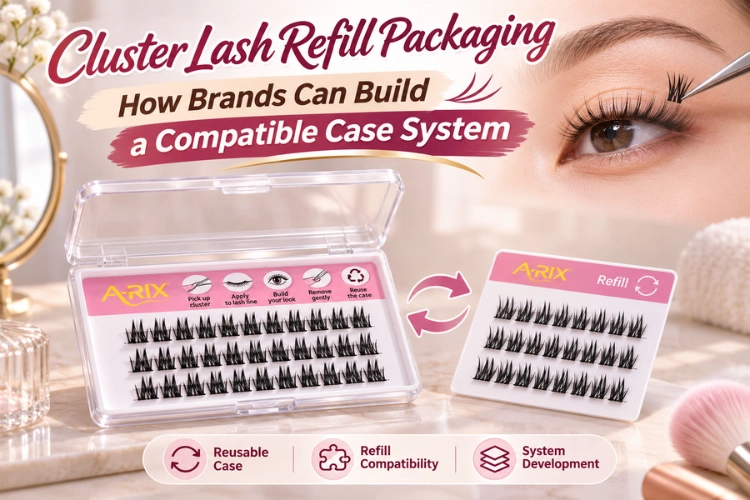
The customer still has the clear case. What, exactly, should they buy next? That is the awkward question behind a cluster lash refill packaging proposal. Three fresh rows on a card sound straightforward until someone has to decide whether the card comes out, where the replacement sits, and which version of the case it belongs to.
Work through one complete combination first: the retained case, the replacement unit, and the filled lash layout. The fit review and the proposed selling price can then be discussed together. Until that work is done, a shell that can be used again is a starting point for development, not proof of a universal refill format.
The decisions here belong to brands and retail buyers considering that development. The practical question is whether the customer can buy the right replacement and use the proposed assembly as intended. Packaging legislation and environmental assessments sit outside this fit review.
Start With the Case You Intend to Keep
Treat the three-row layout as a physical constraint
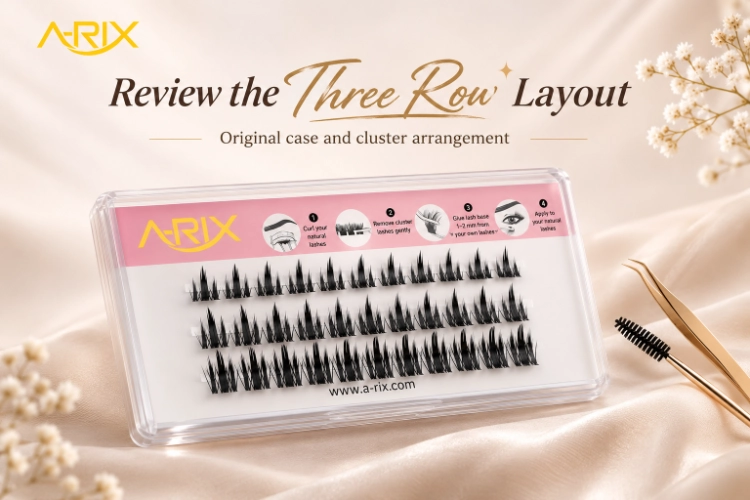
For a starting reference, consider the A-RIX three-row clear injection-molded case. It has a transparent hinged shell and space arranged for three rows of segmented cluster lashes. A-RIX lists it as reusable and stackable, offers custom packaging and logos, and specifies a minimum of 1,000 units for each style.
Ask two questions at the outset: can the existing insert be removed as intended, and what replacement can the supplier develop for it? The listing alone doesn’t answer either. Keep the reusable case on the reference list while treating the separate refill supply as work still to be agreed.
Begin with the actual case sample. Record the base, closure, insert, and lash placement as a combination. If the refill proposal requires a different insert or attachment method, review the revised assembly before calling it compatible.
Decide what the customer retains
Draw the contents of the first purchase beside the contents of the next purchase. Circle everything the customer keeps. This simple exercise exposes whether the proposed refill is a loose strip, an entire three-row insert, or another filled tray, each of which asks the customer to handle something different.
Avoid making the customer discover that distinction after opening the pack. A refill photograph should show exactly what arrives. If the pictured case is only for context, say so clearly in the listing and packaging copy.
Specify the Interfaces in Cluster Lash Refill Packaging
Check the footprint and position
Lower the proposed insert into the actual case and look at where it rests. Does it sit on the intended surface? Is anything near the hinge holding one end up? A matching outline on a drawing is useful, but these are questions for the assembled sample.
Use the assembly review to decide which locations the manufacturer needs to measure. Add those locations and the removal access to the drawing. If someone proposes a clearance from an earlier project, ask what makes it suitable here before accepting it. A dimension is only helpful when its purpose in this case is understood.
Leave room for the lashes under the lid
Fit includes height. Test the filled assembly, not just an empty insert. A case can close over the tray while pressing on the longest or most upright fibers inside it.
Review the selected styles in their packed condition and inspect them after opening. Include any higher-profile style proposed for the same shell. If that style needs another arrangement, give it a separate compatibility decision rather than assuming the shared row count settles the issue.
Make removal part of the review
Give the proposed instructions and sample to someone outside the development discussion. Watch which edge they try first. Having to grasp the lash fibers would be a reason to revisit the removal access, rather than adding another sentence telling the customer to be careful.
Keep a note of the task and the difficulty observed, then revisit either the insert or its instructions. This is work to undertake during development, rather than a completed test of the listed case. The handling instructions must also belong to this DIY cluster product, rather than being copied from a professional extension tray.
Give Each Refill a Clear Identity
Use a compatibility code that survives artwork changes
A collection name is a weak fit reference. It can remain the same while the case construction changes. Use an internal case version and an insert version, then choose a shopper-facing compatibility identifier that stays understandable on a small pack.
The practical record should include:
- Case version and approved sample identification.
- Insert version and filled layout.
- Compatible lash styles and any excluded variants.
- Label and instruction revision.
- The exact replacement unit supplied to the customer.
The buyer should be able to look up the combination from the purchasing specification. Staff memories and social-media pictures are poor substitutes when two versions look almost identical but only one accepts the replacement.
Keep the visual distinction visible
On a small shopping screen, the product image may be read before the title. Photograph the proposed refill on its own, with the retained case used only as clearly explained context. A shopper should be able to tell why the starter costs more without searching the description for the words “case not included.”
Use the A-RIX packaging range to discuss how the replacement will be presented and protected. Lay the proposed saleable unit on the table during that conversation. If its decorative box is being removed, work through what will now prevent movement and contact with the lashes on the route to the customer.
Review the Complete Purchase and Replacement Sequence
Begin with one defined combination
Approve a narrow pilot combination before extending the claim across a collection. Keep the case and insert versions fixed while reviewing how the proposed refill is packed, opened, fitted, and identified.
Then assess additional lash styles against that combination. A change in curl profile or placement can matter even when the insert outline stays identical. Each accepted style should enter the compatibility record deliberately.
Separate fit observations from transport observations
An insert can work on a desk and still arrive displaced. Review the proposed refill in its own shipping configuration, including the protection used around it. Agree on handling and transport checks appropriate to the intended distribution route.
Keep the handling observations with the version of the pack that was reviewed. That record supports a specific development decision; it doesn’t establish a certified transport result or a percentage improvement in damage. A later change to the pack needs its own review of the affected steps.
Plan what happens when the case changes
A new shell version creates a practical question: can existing customers still buy a suitable refill? Decide that before the replacement reaches the warehouse. Keep the earlier version distinguishable for as long as matching stock is offered.
Consider a customer returning to the shop with the first case version after a revised shell has launched. Which refill should staff hand over? Put the identifying code or view where customer service can use it, and make the listing use the same distinction. Keeping the old collection name by itself won’t resolve that customer’s purchase.
Make the Economics Specific to the Proposed System
Have the quotation break out the shell and filled insert, then follow the proposed refill through packing. What holds it during transport, and who assembles that protection? Include those costs and the label in the comparison. The price gap between starter and replacement should be decided from the finished saleable packs, rather than from the missing shell alone.
There is also a limit to what the marketing team can conclude from a reusable shell. The environmental comparison would need to account for replacement materials and actual customer behavior, including whether people keep the case at all. Describe the intended reuse now; a claim about environmental savings needs a separate assessment.
A-RIX’s private-label starting quantity is 1,000 boxes, with mixed assortments supported. Packaging starts at 1,000 boxes too, and this particular case is listed at 1,000 units per style. Those terms should appear against the relevant components on the quotation so the buyer knows what the proposed refill development actually requires.
Allow around seven days for the first-round sample dispatch, followed by the buyer’s fit review and any further development. Once agreed, retain the assembly as a sealed reference for matching bulk production. Discuss color boxes, blister formats, white cards, or another agreed format through A-RIX custom development services, with the proposed replacement unit in view.
Questions Before Calling the Product Refillable
Can any three-row insert fit a three-row case
No. Three rows tell the buyer something about the arrangement of the lashes, but very little about the underside of the insert or the space beneath the lid. A different outline or seating height can change the fit. Keep the compatibility claim specific to the versions reviewed as an assembly.
Does the clear case already include a refill program
The current listing is for the reusable three-row case. Ask separately about developing the replacement supply and a removable insert. Until that work is agreed and approved, purchasing records and commercial images should identify the refill as a development concept, so no one mistakes it for a ready-to-order replacement SKU.
What should the first development inquiry contain
Send the intended case, proposed replacement unit, lash layout, sales channel, and compatibility expectations. Include how the shopper will recognize and replace it. The A-RIX DIY cluster lash range can help identify the lash family before the proposed assembly is reviewed.
At the end of development, put the first purchase beside the next one again. The customer should be able to explain which parts they keep and which they replace, using the proposed packaging alone. That is a useful final review of cluster lash refill packaging before the brand spends money promoting the offer.